
The Mechanics Behind Every Mortgage Payment
If you've ever glanced at your mortgage statement and wondered why your balance hardly seems to move in the first few years, amortization is the answer. To understand how a mortgage works at a foundational level is to understand amortization — they are inseparable.
Here is the core idea: your lender calculates interest each month based on the loan balance still outstanding. Early in the loan, that balance is large, so interest consumes a big share of each payment. As you pay down the balance month by month, less interest accrues, and more of your fixed payment automatically flows toward principal. This self-adjusting split is built into every standard mortgage from day one.
Consider a simplified example. On a $300,000 mortgage at 6.5% interest over 30 years, your monthly payment might be roughly $1,896. In month one, approximately $1,625 of that goes to interest and only about $271 reduces your balance. By year 15, the split is closer to an even divide. By year 28, most of each payment goes straight to principal. The payment never changes — but what it accomplishes does.
~89%
Interest share of first payment on a 30-year, 6.5% mortgage
On a $300,000 loan at 6.5%, the first monthly payment is roughly 89% interest and 11% principal — a ratio that reverses only gradually over time.
30 years
Most common U.S. mortgage term
The 30-year fixed-rate mortgage remains the dominant loan product for U.S. homebuyers, according to Freddie Mac historical origination data.
~$186,000
Total interest on a $300,000 loan at 6.5% over 30 years
A borrower who makes only minimum payments on a $300,000 mortgage at 6.5% would pay roughly $186,000 in interest over the loan's full term — more than half the original loan amount.
Reading an Amortization Schedule
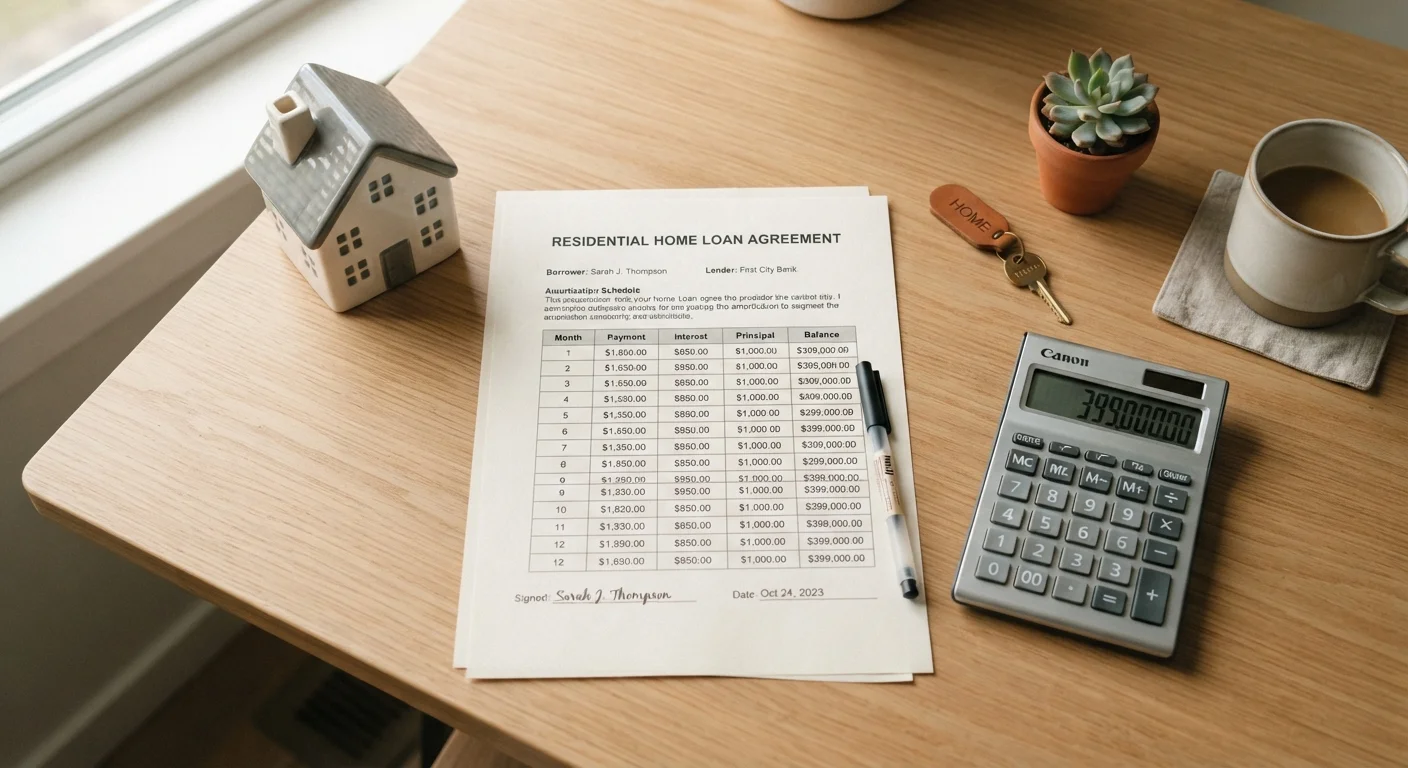
An amortization schedule is a complete payment-by-payment table showing the interest portion, principal portion, and remaining balance for every month of your loan. Your lender must provide one at closing, and it is one of the most useful documents a homeowner can keep on hand.
Each row in the schedule tells a small part of the same larger story: the balance is slowly declining, the interest charge on each row is slightly smaller than the one before it, and the principal applied is slightly larger. Over a 30-year mortgage, that gradual shift is nearly invisible from one month to the next — but dramatic when you compare year one to year twenty.
Reviewing your schedule also reveals when you will cross meaningful equity milestones — for instance, when your loan-to-value ratio drops below 80%, which typically allows you to cancel private mortgage insurance (PMI). For a deeper look at all the components that make up your monthly bill, see inside your monthly mortgage payment.
Use an Amortization Calculator Before You Commit
Before signing any loan, run the numbers through a free amortization calculator using your actual loan amount, interest rate, and term. This shows your exact payment breakdown for every month and reveals your total interest cost — not just the monthly payment figure lenders often lead with. Many lenders and nonprofit housing counseling organizations offer these tools at no cost.
How Extra Payments Change the Picture
Because interest is calculated on the remaining balance, anything that reduces that balance faster also reduces how much interest accumulates going forward. Even occasional extra principal payments — an extra $100 a month, or a single lump-sum payment from a tax refund — can shave years off a 30-year mortgage and save tens of thousands of dollars in total interest, depending on loan size and rate.
The key is making sure extra funds are applied to principal, not simply counted as an early payment of next month's regular installment. Contact your servicer to confirm how to designate extra payments correctly.
Homeowners exploring debt reduction more broadly will find practical guidance in the Saving & Debt Tips hub, which covers strategies for managing household debt alongside building savings.
Amortization and Refinancing: Starting the Clock Over
Refinancing replaces your existing mortgage with a new one — ideally at a lower interest rate or on different terms. But because a new loan comes with a new amortization schedule, you effectively restart the interest-heavy early phase. If you are 10 years into a 30-year mortgage and refinance into a new 30-year loan, you may lower your monthly payment while extending the timeline and paying more total interest over the full term.
This does not mean refinancing is a poor choice — lower rates genuinely reduce costs in many scenarios — but it requires looking at the full picture rather than just the monthly payment. Calculate the total interest paid under both the old and new loan terms before deciding. A qualified financial professional can help you run these numbers for your specific situation.
Variable-rate loans add another layer of complexity. Unlike fixed-rate mortgages, their schedules can shift when rates adjust. How interest rate changes affect what you owe explains how those fluctuations translate into real monthly dollar changes.
This article is for general informational and educational purposes only and does not constitute personalized financial or mortgage advice. Consult a licensed financial advisor or mortgage professional for guidance tailored to your situation.