
What These Two Terms Actually Mean
When you file a property or auto insurance claim, your insurer uses a valuation method to calculate your payout. The two most common methods are Actual Cash Value (ACV) and Replacement Cost Value (RCV). Understanding which one applies to your policy — before you ever need to file a claim — is one of the most important things a new policyholder can do.
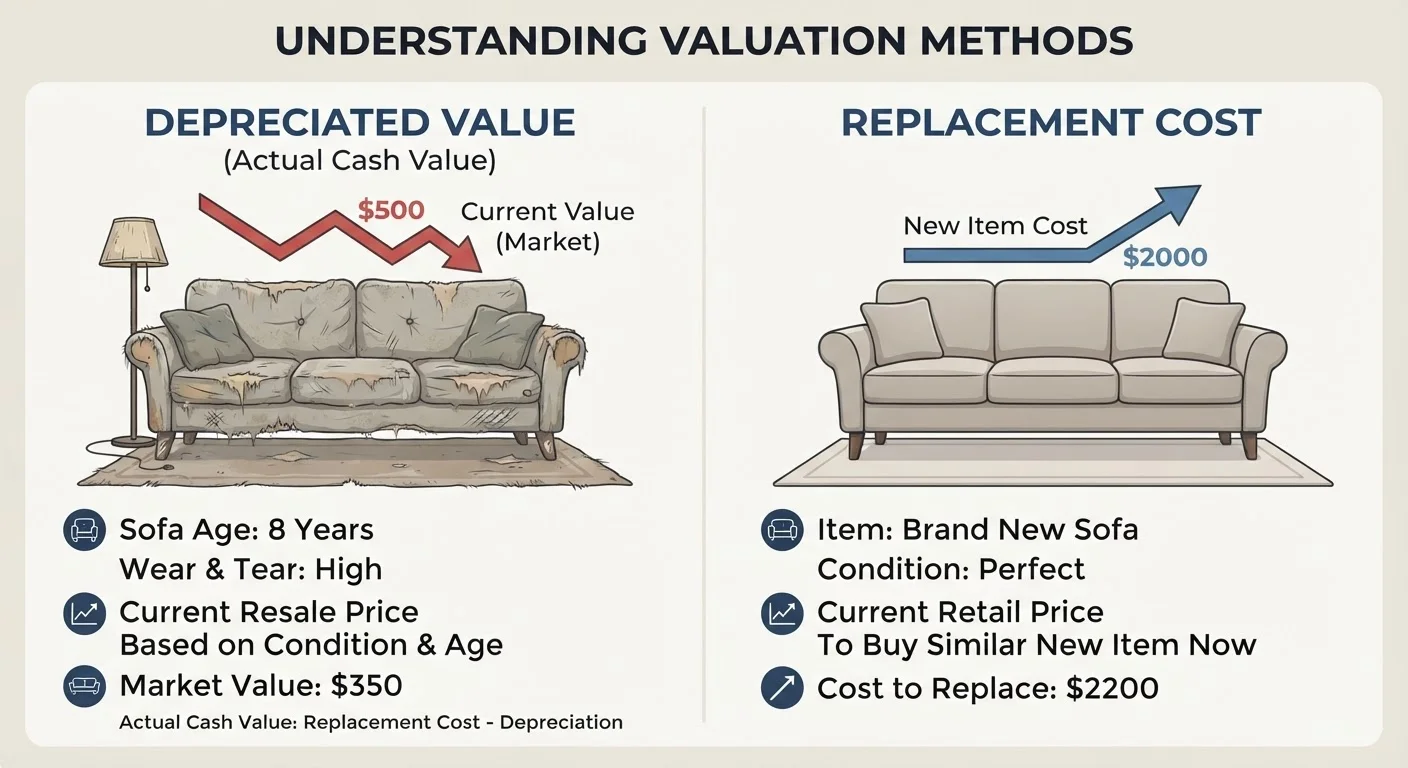
Actual Cash Value is what your property was worth at the moment of loss, accounting for age, wear, and depreciation. Think of it as the resale or market value. Replacement Cost Value, by contrast, is what it would cost to buy a comparable new item at today's prices, with no depreciation deducted.
The distinction matters enormously. A five-year-old sofa that cost $1,200 might have an ACV of $400 after depreciation — but replacing it today could cost $1,100. Under an ACV policy, you receive $400. Under an RCV policy, you receive an amount closer to $1,100. That $700 gap comes out of your pocket under ACV coverage. As noted in common policy misreads, confusing these two methods is one of the most costly mistakes policyholders make.
How Each Payout Is Calculated
Insurers calculate ACV using a straightforward formula: Replacement Cost minus Depreciation equals ACV. Depreciation is determined by the item's expected useful life and its current age. A roof with a 20-year lifespan that is 10 years old may be considered 50% depreciated — so if replacing it costs $20,000, an ACV payout might be around $10,000.
RCV works differently. Your insurer typically pays a two-step benefit: an initial payment reflecting ACV, followed by a recoverable depreciation supplement once you provide proof that you completed the repair or replacement. This means you may need to pay out of pocket initially and then submit documentation to recover the remainder.
| Criterion | Actual Cash Value (ACV) | Replacement Cost Value (RCV) |
|---|---|---|
| Payout basis | Depreciated market value at time of loss | Cost to buy equivalent new item today |
| Depreciation deducted | Yes — subtracted from payout | No — recoverable after replacement |
| Premium cost | Generally lower | Generally higher |
| Out-of-pocket gap risk | Higher — especially for older items | Lower — closer to full replacement |
| Common use in auto insurance | Standard for most auto policies | Less common; may apply to newer vehicles |
| Payment process | Single lump-sum payout | Initial ACV payment plus recoverable depreciation |
For auto insurance, the same logic applies. ACV is the standard for most auto policies — your car's market value at the time of loss is what you receive, not what you paid for it. Understanding how vehicle depreciation works helps explain why an ACV payout on a three-year-old car can feel significantly lower than expected. For context on how auto coverage types interact with these valuations, see collision vs. comprehensive coverage.
Trade-Offs: Premiums, Payouts, and Policy Limits
RCV coverage offers stronger financial protection, but it comes at a cost. Premiums for RCV policies are generally higher than for comparable ACV policies because the insurer's potential payout is larger. The right choice depends on factors like the age of your property, your available savings, and your tolerance for out-of-pocket exposure after a loss.
~50%
Typical depreciation on a 10-year-old roof
Insurers often apply straight-line depreciation based on an item's expected useful life, which can halve the ACV payout on older structural components.
20%+
Potential premium difference between ACV and RCV
Industry guidance generally suggests RCV homeowners policies carry meaningfully higher premiums, though exact differences vary by insurer, location, and property type.
It's also worth noting that neither ACV nor RCV operates without limits. Your policy will have a coverage limit — a maximum the insurer will pay — and possibly sub-limits for specific categories like jewelry or electronics. Even with RCV coverage, a payout cannot exceed your policy's ceiling. Review how coverage limits and sub-limits work to understand how these caps interact with your valuation method.
Check Your Policy Before a Loss Occurs
Your policy's declarations page and definitions section will state which valuation method applies. Some policies use ACV for certain items (like roofs) and RCV for others. If your policy language is unclear, ask your insurer or a licensed agent to explain exactly how a claim would be calculated — before you ever need to file one.
This article provides general insurance education and is not personalised advice. Coverage terms, depreciation schedules, and payout calculations vary by insurer and policy. Always read your policy documents carefully and consult a licensed insurance agent for guidance specific to your situation.