
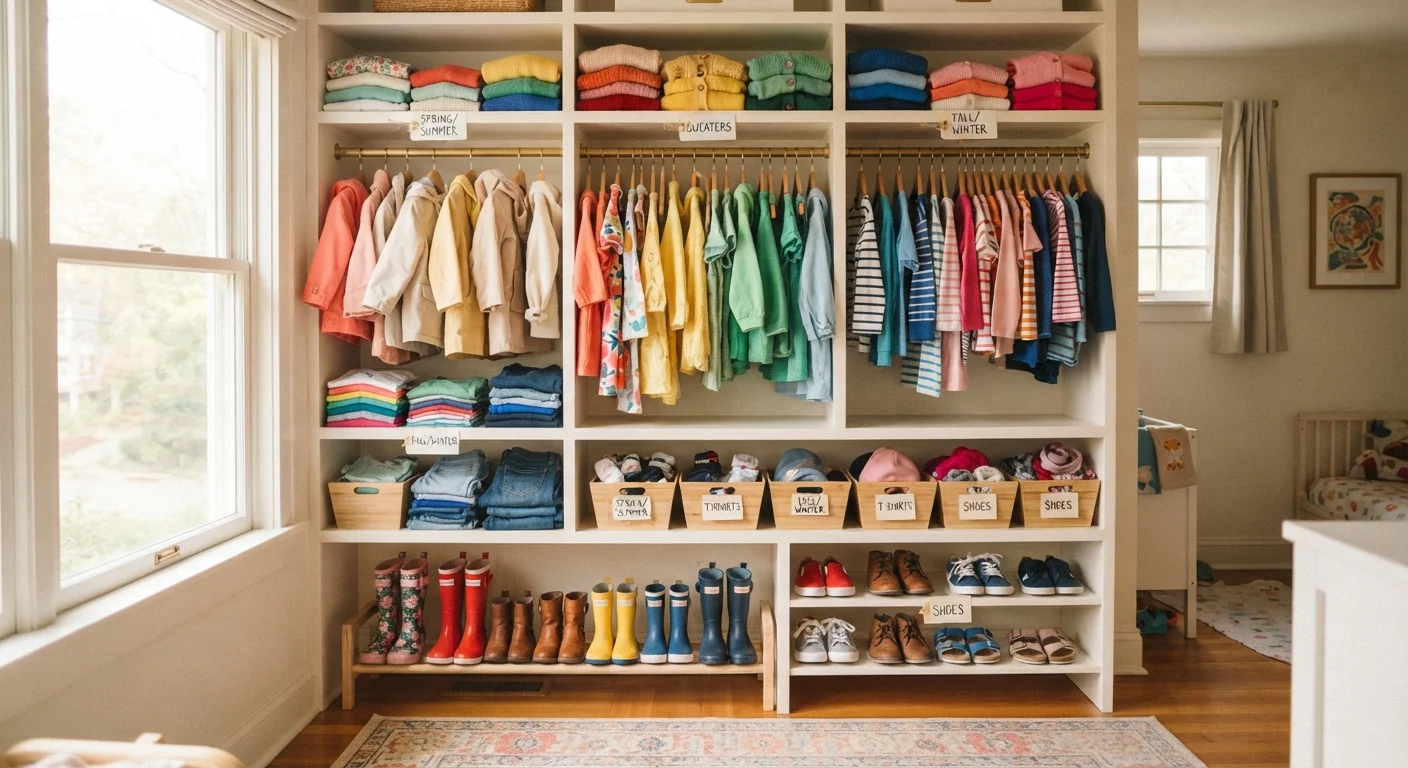
Why a Season-by-Season Approach Actually Saves Money
Buying children's clothing reactively — grabbing whatever's needed when it's suddenly needed — is one of the most common ways families overspend on kids' wardrobes. A season-by-season framework replaces that scramble with a calm, predictable rhythm. Instead of one enormous back-to-school haul followed by months of gap-filling, you spread decisions (and spending) across the year in manageable chunks.
This approach also works with how children actually grow and change. Tastes shift, sizes change mid-season, and activity levels vary by time of year. Planning by window lets you adapt rather than over-commit. For families building a full household wardrobe strategy, our guide on dressing a family of four without blowing the budget offers a broader financial framework that complements this seasonal approach.
Understanding how sizing actually works is also foundational before you plan — children's clothing labels can be notoriously inconsistent. Our reference guide on how children's clothing sizes work across age ranges can help you shop with confidence whether you're browsing in-store or online.
What you will need
What You'll Need Before You Start
A little preparation before diving into the steps makes the whole process smoother. Gather the tools below, and you'll spend less time second-guessing and more time making confident choices.
Measuring tape
Take accurate body measurements to cross-reference against size charts before buying.
Seasonal clothing checklist
A written or digital list of needed items per season helps avoid duplicate and impulse purchases.
Laundry-frequency planner
Knowing how often you do laundry helps determine the minimum number of outfits needed per season.
If your child's school has specific uniform policies, check those requirements before planning any shopping window — uniform items often need to be prioritized and budgeted separately. Our article on navigating school uniform policies on a budget walks through the most common dress code situations families encounter.
Season-by-Season Steps
Follow these steps at the start of each school-year clothing window. The process takes roughly 15–30 minutes of planning time and can prevent hours of frustrating, reactive shopping later in the season.
Audit What You Already Own
Before buying a single new item, pull out everything your child currently owns and sort it into three piles: fits now, too small or worn out, and borderline (might last the season). Only the first pile counts as usable inventory. This honest starting point tells you exactly what categories need attention — and prevents you from buying duplicates. For a structured approach, see our seasonal wardrobe audit checklist.
Map Out the School Year by Season
Divide the school year into four clothing windows: Late Summer/Early Fall (August–October), Winter (November–February), Spring (March–May), and End-of-Year (May–June). Each window has distinct temperature demands and activity levels. Mapping these out in advance helps you allocate budget across the year rather than facing a large, stressful expense every few months.
Build Your Late Summer and Fall Core
This is the heaviest shopping window for most families. Focus on breathable, lightweight layers: short-sleeve tops, one or two long-sleeve shirts, a pair of jeans or sturdy trousers, and a light jacket or hoodie. Aim for a color palette where most pieces can mix and match — this dramatically multiplies outfit combinations from a small number of items. For fabric guidance, our article on natural fabrics vs. synthetics for children's clothing explains how different materials perform across school-day activities.
A general starting point for a weekly rotation: 5 tops, 3 bottoms, 1 jacket, and 1 pair of supportive sneakers. Adjust up or down based on your laundry frequency.
Layer Up for Winter Without Buying a Completely New Wardrobe
Winter doesn't require starting over — it requires adding to what already works. The existing fall wardrobe becomes a base layer. Add a midlayer (a fleece or lightweight sweater), a waterproof or insulated outer coat, thermal underlayers for very cold climates, warm socks, and waterproof boots or insulated shoes. A good winter coat is often the single most significant investment of the school year; choose one that fits well now but allows a little room for growth.
[important_callout]Transition to Spring With Strategic Swaps
Spring is the most forgiving season budget-wise. Temperatures are variable, so layering again does the heavy lifting. Lightweight long-sleeve tops, a waterproof rain jacket, and a pair of transitional sneakers or waterproof shoes generally cover the full spring window. Pull back out any fall items that still fit — many will. Spring is also a good time to identify summer gaps early, since back-to-school shopping in late summer often catches families off-guard.
Plan Ahead for the Following Year
At the end of each school year, note which items held up well, which wore out faster than expected, and how much your child grew. This information shapes smarter decisions for the next August. End-of-school-year clearance periods often offer significantly reduced prices on kids' clothing — buying one size up in durable, gender-neutral basics during these windows can yield real savings. For more on timing purchases strategically, see our year-round family shopping savings guide.
Track Gaps With a Simple List
Keep a running note on your phone of items your child outgrows or wears out mid-season. Shopping with a specific list prevents impulse purchases and makes it much easier to take advantage of mid-season markdowns on exactly what you need. A quick seasonal wardrobe check — like the one outlined in our family clothing audit guide — takes about 15 minutes and pays off all season long.
For families who want to go further, building a true capsule wardrobe — a small, curated set of versatile pieces — is a natural next step. Our capsule wardrobe basics for kids article explains the concept in plain terms and shows how fewer, better-chosen pieces can actually cover more of a child's daily life. And if you want to understand which specific clothing items pull double duty across school, play, and family outings, versatile wardrobe pieces that work for school, play, and family occasions is worth a read.
Avoid Over-Buying Before the Year Starts
It's tempting to stock up on a full wardrobe in August, but children's tastes, school dress codes, and body proportions can all shift within weeks. Buy core essentials upfront and leave room in your budget to fill gaps once the school year is actually underway. This is especially important for shoes, which should always be fitted on the child before purchasing.