
What Each Valuation Method Actually Means
When you file a property insurance claim, your insurer doesn't simply hand over whatever amount you ask for. Instead, the payout is calculated using a valuation method written into your policy. The two most common methods are Actual Cash Value (ACV) and Replacement Cost Value (RCV). Understanding the difference before you buy — not after you file a claim — is one of the most important things you can do as a policyholder.
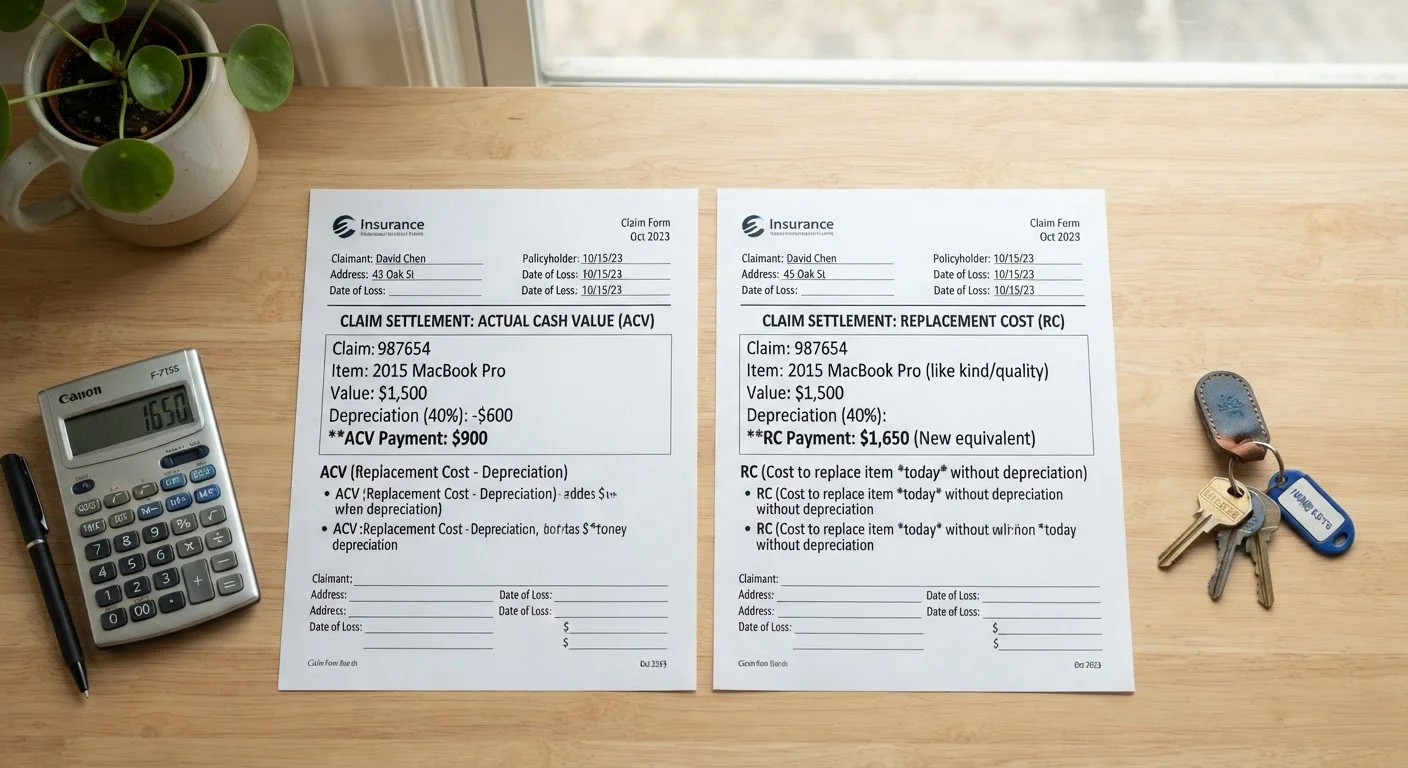
Actual Cash Value pays you what the damaged or destroyed property was worth at the moment of the loss. That figure is calculated by taking the item's original value and subtracting depreciation — the decline in value caused by age, wear, and obsolescence. The older or more worn an item, the less it is worth, and the smaller your payout will be.
Replacement Cost Value pays you what it would cost to repair or replace the damaged property with a comparable new item at today's market prices. Depreciation is not subtracted. If your five-year-old roof is destroyed in a hailstorm, an RCV policy pays to install a new roof at current labor and material costs — not a fraction of that amount based on how old the existing roof was.
For a deeper look at how these calculations are applied in practice, see how ACV and replacement cost payouts are calculated.
A Side-by-Side Comparison
The table below distills the key differences between these two valuation approaches across the dimensions that matter most to homeowners and families.
| Criterion | Actual Cash Value (ACV) | Replacement Cost Value (RCV) |
|---|---|---|
| How payout is calculated | Current value minus depreciation | Cost to repair/replace at today's prices |
| Depreciation deducted | Yes | No |
| Typical premium cost | Lower | Higher |
| Out-of-pocket gap after a claim | Potentially significant | Minimal (beyond deductible) |
| Best suited for | Budget-focused buyers with savings buffer | Families wanting full restoration coverage |
| Common policy types | Basic home, older auto policies | Standard homeowners, contents coverage |
One important nuance: some RCV policies operate in two stages. The insurer first pays the ACV amount when the claim is settled, then releases the remaining recoverable depreciation once you complete the repair or replacement. This means you may need to fund repairs upfront and claim the balance — so always read your policy's specific terms.
Check Your Policy's Specific Language
The terms "actual cash value" and "replacement cost" must appear explicitly in your policy documents — typically in the Conditions or Definitions section. Do not assume which method applies based on the premium alone. If your policy is unclear, ask your insurer or agent to confirm in writing which valuation method applies to each coverage category, as some policies use different methods for the dwelling versus personal property.
How the Numbers Play Out in Real Scenarios
Abstract definitions are useful, but dollar figures make the difference tangible. Consider a few common household examples.
- Roof damage: A roof installed 10 years ago might have a replacement cost of $15,000 today. If the insurer assigns it a 20-year useful life and 50% depreciation, an ACV payout would be roughly $7,500. An RCV payout would be the full $15,000 (minus your deductible).
- Personal property: A laptop purchased four years ago for $1,200 might be valued at $400 under ACV due to technological depreciation. RCV would pay closer to the current cost of a comparable new model.
- Appliances: A washer-dryer set worth $1,800 new, now eight years old, might yield only a few hundred dollars under ACV. RCV would fund a new replacement set.
~50%
Typical ACV payout on a 10-year-old roof
A common industry depreciation schedule assigns roofing materials a 20-year useful life, meaning a decade-old roof may be valued at roughly half its replacement cost under ACV.
10–20%
Typical premium difference between ACV and RCV
Replacement cost policies generally cost more than ACV equivalents; the exact difference varies by insurer, property type, and location.
These gaps illustrate why families often feel underinsured after a claim even when they thought they had adequate coverage. Knowing your valuation method in advance prevents that surprise. You can also explore common policy misunderstandings that cost families money to avoid related pitfalls.
Weighing the Trade-Off: Premium Savings vs. Claim Protection
ACV policies generally carry lower premiums than RCV policies because the insurer's maximum payout exposure is capped by depreciation. That trade-off is worth understanding clearly: you pay less each month, but you absorb more financial risk if a significant loss occurs.
RCV policies cost more upfront but provide a stronger financial safety net. For families who could not comfortably fund a new roof, rebuilt structure, or full household contents replacement out of savings, the higher premium may be a sound investment in financial protection.
When comparing policies, valuation method should sit alongside deductibles, coverage limits, and exclusions as a core evaluation criterion — not an afterthought. Comparing policies beyond the premium walks through a practical framework for doing exactly that. Also keep in mind that coverage sub-limits can further affect payouts; how coverage caps and sub-limits work explains those constraints clearly.
This article is for general informational and educational purposes only and does not constitute personalised insurance, financial, or legal advice. Coverage terms, valuations, and premiums vary by provider, policy, and location. Always read your policy documents carefully and consult a licensed insurance agent or adviser for guidance specific to your situation.