
What Each Term Actually Means
Before comparing premiums and deductibles, it helps to understand exactly what each one is — and what it is not.
A premium is the amount you pay your insurer to maintain active coverage. It is typically billed monthly, semi-annually, or annually. Think of it as the cost of having the policy itself. Paying your premium does not mean your insurer pays every claim dollar-for-dollar — it simply means your coverage is in force.
A deductible is the portion of a covered loss you agree to pay yourself before your insurer contributes. For example, if your home insurance policy has a $1,500 deductible and a covered storm causes $6,000 in damage, you pay the first $1,500 and your insurer pays the remaining $4,500. If the damage had only totaled $900 — below the deductible — your insurer would pay nothing, and the full cost would fall to you.
For a plain-English look at these and other common terms, see the home and auto insurance glossary for new policyholders.
| Criterion | Premium | Deductible |
|---|---|---|
| What it is | Regular payment to keep coverage active | Your share of a covered loss at claim time |
| When you pay it | On a set schedule (monthly, annually, etc.) | Only when you file a qualifying claim |
| Effect on the other | Lower if deductible is higher | Higher if premium is lower |
| Predictability | Fixed and predictable each billing cycle | Variable — triggered only by a covered loss |
| Risk it represents | Ongoing, certain cost | Potential large sudden cost |
| Who it benefits most | Insurer receives steady income; you get coverage | Lower deductible benefits frequent claimants |
The Inverse Relationship: How They Move Together
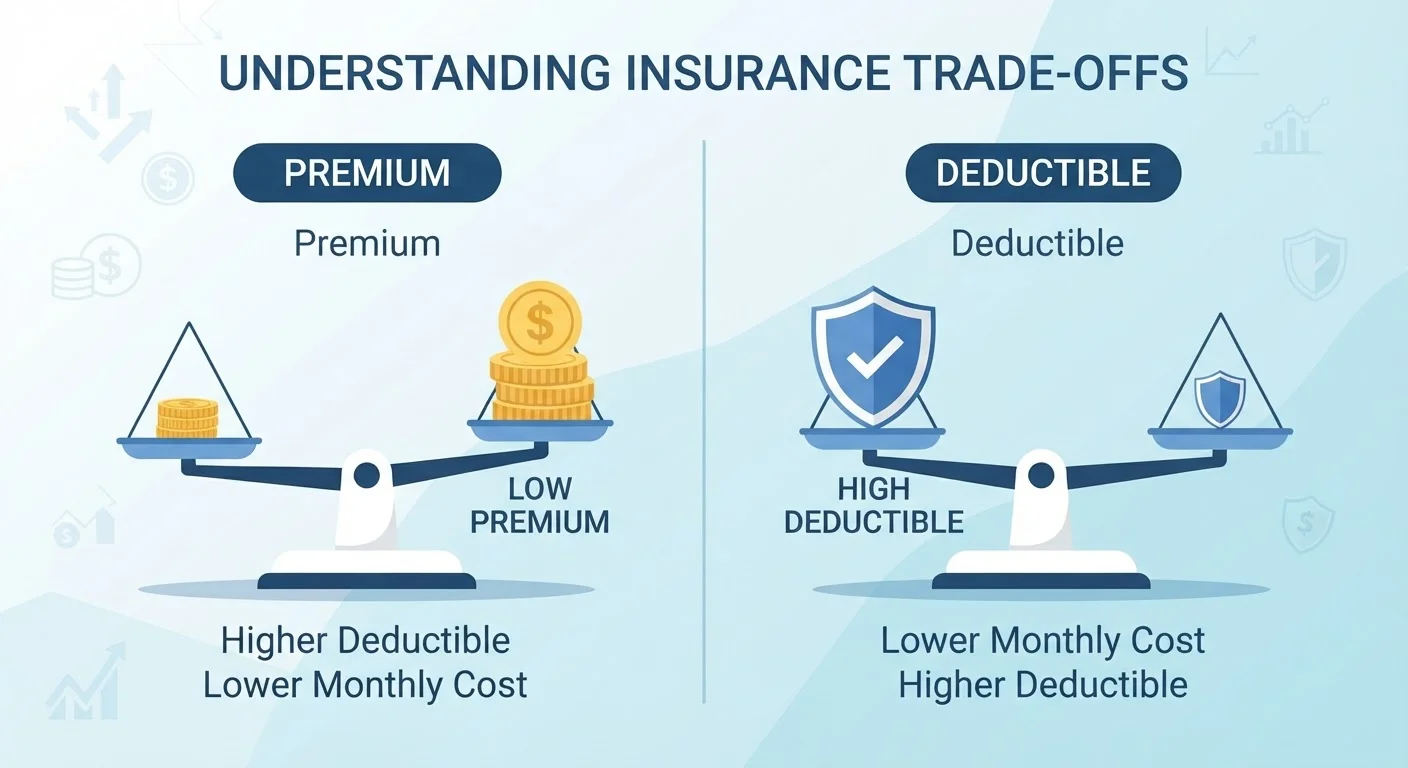
Premiums and deductibles generally move in opposite directions. This is one of the most important mechanics to understand when evaluating any policy.
- Higher deductible → lower premium. When you agree to absorb more of the initial loss yourself, the insurer takes on less risk — and prices the policy accordingly.
- Lower deductible → higher premium. When the insurer is on the hook sooner after a claim, they charge more to carry that exposure.
This relationship is not unique to one type of insurance. It applies to home, auto, and health coverage alike. The true annual cost of a health insurance deductible illustrates how this dynamic plays out across healthcare expenses over time.
$500–$2,500
Typical home insurance deductible range
According to general industry data, most standard homeowners policies allow deductible choices within this range, directly affecting annual premium costs.
~15–30%
Potential premium reduction from raising deductible
Insurance educators note that doubling a deductible can reduce a premium by a meaningful percentage, though exact figures vary widely by insurer, policy type, and state.
The trade-off is fundamentally about when you pay, not whether you pay. A lower premium shifts some financial risk to you at claim time. A higher premium shifts that risk back to the insurer — for a price paid upfront and repeatedly.
How to Think About the Right Balance for Your Household
There is no single correct answer to "how high should my deductible be?" The right structure depends on your household's specific financial picture. Consider the following factors:
- Emergency savings. A high deductible only makes sense if you have accessible savings to cover it. If a $2,000 deductible would create a genuine hardship, it may be too high regardless of the premium savings.
- Claim likelihood. Think honestly about your risk exposure. A home in a flood-prone area or a driver with a long commute may face higher claim frequency than average — reducing the appeal of a high deductible.
- Monthly cash flow. If a lower monthly premium meaningfully eases your budget, that has real value. But weigh it against the risk of a large, sudden out-of-pocket payment.
- Policy type. Some policies — particularly auto collision coverage — allow significant deductible flexibility. Others may have fixed deductibles for specific perils. Always verify what is adjustable before assuming.
When shopping for coverage, it pays to look beyond the premium alone. The framework for comparing policies beyond the premium walks through the broader evaluation process, including deductibles, exclusions, and claims service.
For households working to align insurance decisions with their overall spending plan, the home budgeting hub offers practical guidance on managing household expenses.
Deductibles Can Vary Within One Policy
Some policies apply different deductibles to different types of losses. For example, a homeowners policy might carry a standard dollar-amount deductible for most claims but a separate percentage-based deductible for wind or hail damage. This is common in coastal and storm-prone states. Always review your full declarations page to understand which deductible applies to which peril.
This article is for general informational and educational purposes only and does not constitute personalised insurance, financial, or legal advice. Coverage terms, deductibles, and premiums vary by insurer, policy, and state. Always read your full policy documents and consult a licensed insurance agent or adviser for guidance specific to your situation.