
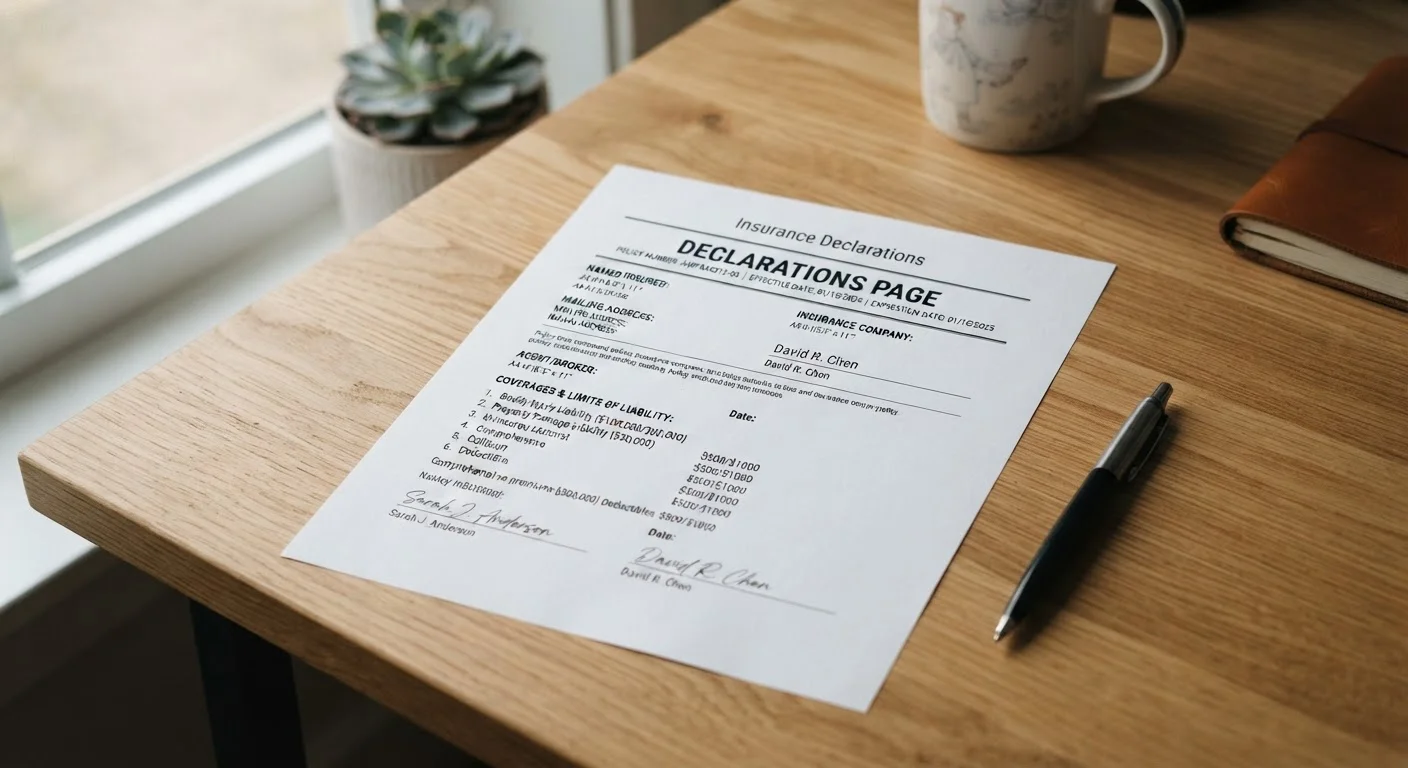
What You'll Actually Find on a Declarations Page
Open any home or auto insurance policy and the declarations page is the first thing you see. It is designed to give you — and your insurer — a fast reference for the most essential facts of your agreement. Here is what it typically contains:
- Named insured: The person or persons the policy legally covers.
- Policy period: The exact start and end dates of coverage.
- Insured property: The address of your home or the year, make, and model of your vehicle.
- Coverage types and limits: For example, $300,000 in dwelling coverage or $100,000 in liability coverage.
- Deductible: The amount you pay out of pocket before your insurer contributes to a claim.
- Premium: The total cost of the policy for the coverage period.
- Endorsements listed: Any add-ons or modifications to the standard policy that apply to your contract.
For a plain-English explanation of terms like deductible and premium, see our home and auto insurance glossary.
1–2 pages
Typical length of a declarations page
Despite being the most-read part of a policy, the dec page represents only a small fraction of the full policy document, which can run 20–60+ pages.
~33%
Homeowners who misunderstand their coverage
Industry consumer research consistently finds that a significant share of policyholders overestimate what their standard home policy covers, often because they rely on the dec page summary alone.
What the Declarations Page Leaves Out
Here is where many policyholders get into trouble: the dec page tells you how much coverage you have, but it does not tell you when that coverage applies — or when it doesn't. The details that truly define your protection live elsewhere in the policy document.
What is missing from the dec page:
- Exclusions: Specific events, causes of loss, or situations your insurer will not pay for. Flood damage under a standard homeowners policy is a classic example — it is excluded, but that fact does not appear on the dec page.
- Conditions: Your responsibilities as a policyholder, such as reporting a claim promptly or maintaining the property.
- Definitions: Precise legal meanings of words like "occurrence," "property," or "covered peril" that control how claims are interpreted.
- Insuring agreements: The exact promises your insurer is making and the triggers required to activate coverage.
Understanding why the exclusions section matters is essential before you assume you're protected against a specific risk. A high coverage limit on your dec page means little if the cause of your loss is excluded.
Make a Coverage Checklist from Your Dec Page
When you receive a new or renewed declarations page, use each coverage line as a prompt to locate and skim the corresponding section in your full policy. This habit takes 15–20 minutes and can prevent costly surprises at claim time. Pay special attention to any endorsements listed — they often contain both added protections and new exclusions.
How to Use Your Declarations Page Wisely
The dec page is a useful starting point, not a finishing line. Here is a practical approach for making the most of it:
- Check it for accuracy immediately. Confirm the named insured, property address or vehicle description, coverage amounts, and deductible are all correct. Mistakes here can complicate or delay claims. If anything is wrong, contact your insurer right away.
- Use it as a map. The coverage types listed on the dec page — liability, collision, dwelling, personal property — tell you which sections of the full policy to read for details.
- Compare limits to your actual exposure. If your home would cost $400,000 to rebuild but your dwelling coverage limit is $250,000, that gap shows up on the dec page. Spotting it early allows you to adjust before a loss occurs.
- Cross-reference endorsements. If your dec page lists an endorsement — such as water backup coverage or a scheduled personal property rider — locate that endorsement in your policy to understand what it actually covers and what it excludes.
For a deeper walk-through of how a full policy is structured, our guide on the anatomy of an insurance policy explains each section in plain terms. If you are new to reading policies entirely, our starter guide for first-time policyholders is a good next step.
This article is for general informational and educational purposes only and does not constitute personalized insurance, legal, or financial advice. Coverage terms, exclusions, and eligibility vary by insurer and state. Always read your complete policy documents and consult a licensed insurance agent or adviser for guidance specific to your situation.