
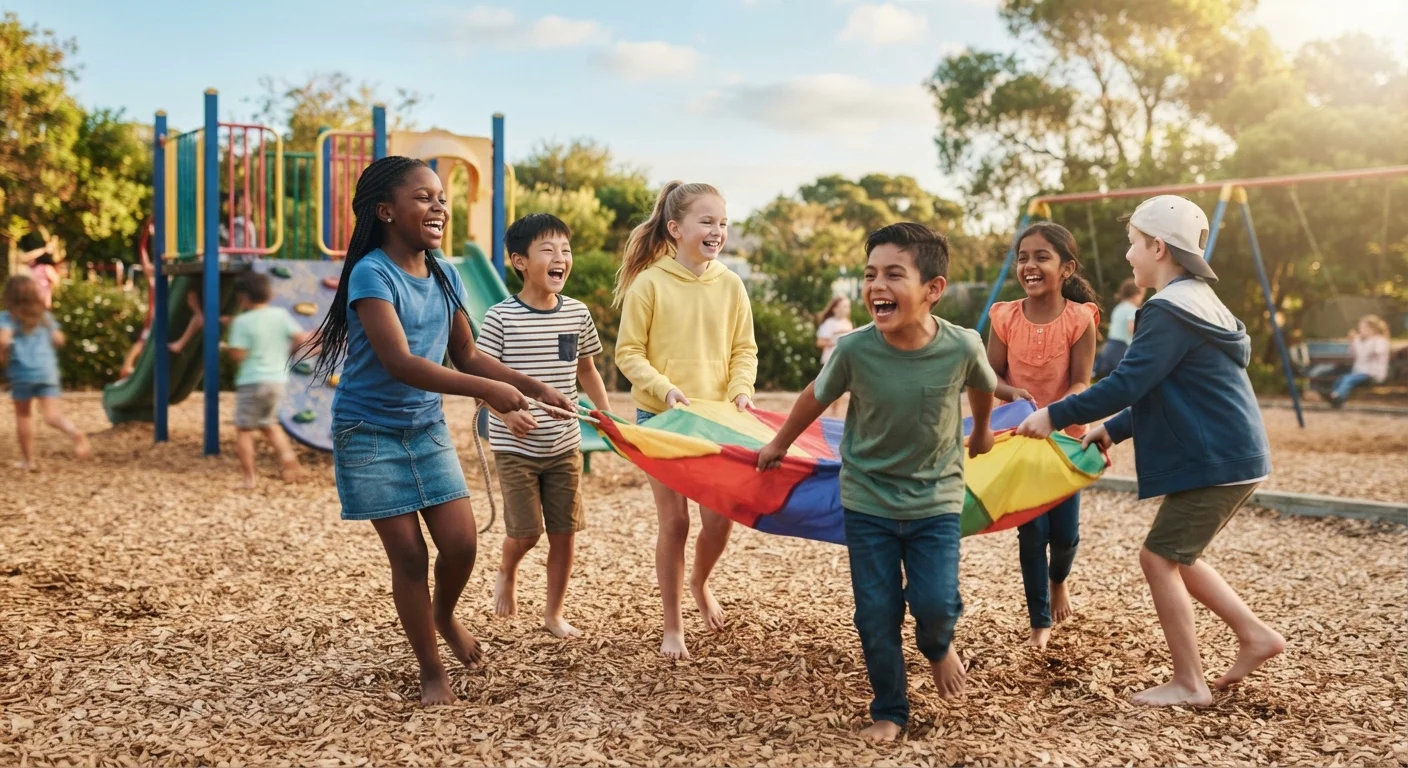
What Social Development Looks Like Between Ages 5 and 12
Social development during the school-age years isn't a single skill - it's a layered process that includes making friends, managing disagreements, understanding other people's feelings, and learning to cooperate. The pace varies considerably from child to child, and a wide range of timelines is considered typical.
| Age range covered | 5 to 12 years old |
| Key social skill emerging at age 5-6 | Cooperative play and basic empathy (CDC Developmental Milestones) |
| Key social skill emerging at age 8-10 | Perspective-taking and sustained friendship (American Academy of Pediatrics) |
| Normal variation | Wide range of timelines is typical |
| Professional to consult | Pediatrician or school counselor |
Between ages 5 and 7, children are typically moving from parallel play (playing alongside others) to genuinely cooperative play. They begin forming stable friendships, often based on shared activities rather than deep emotional connection. They may be sensitive to fairness - "that's not fair" becomes a common phrase - and start to recognize that other people have different thoughts and feelings than they do.
From around ages 8 to 12, social complexity increases noticeably. Children develop more nuanced friendships, navigate peer group dynamics, and start to value loyalty and trust. They also become more aware of social norms and how they appear to others - a shift that can occasionally lead to self-consciousness. These developments are part of healthy growth, not warning signs. For a broader picture of milestones that don't always get attention, see developmental milestones parents sometimes overlook.
Key Social Milestones to Know
The following are widely recognized markers of healthy social development. Remember that children reach these at different ages, and occasional setbacks - especially during transitions like starting a new school - are normal.
Parallel play
A stage of play where children play near each other but independently, without direct interaction. It is normal in toddlers and early preschool years and gradually gives way to cooperative play.
Cooperative play
Play that involves shared goals, turn-taking, and communication among children. It typically becomes consistent between ages 4 and 6 and is a foundation for friendship skills.
Empathy
The ability to recognize and share the feelings of another person. In school-age children, empathy develops gradually and becomes more nuanced throughout the elementary years.
Perspective-taking
The cognitive ability to understand that other people have different thoughts, feelings, and viewpoints. This skill deepens significantly between ages 7 and 10.
Peer group
A social group of children of similar age who share activities, interests, or school environments. Peer group belonging becomes increasingly important from around age 8 onward.
Social regression
A temporary return to earlier social behaviors - such as increased clinginess or conflict - often triggered by stress, transitions, or major life changes. Brief regressions are common and usually resolve on their own.
- Ages 5-6: Shows preference for certain friends; takes turns in games; expresses sympathy when others are hurt; begins understanding simple rules in group play.
- Ages 7-8: Maintains friendships over several months; works through minor disagreements with words rather than physical action; understands winning and losing with reasonable composure.
- Ages 9-10: Forms close, same-age friendships; shows genuine empathy; can consider multiple perspectives in a conflict; participates in group projects with shared goals.
- Ages 11-12: Develops a small circle of trusted peers; navigates social hierarchies; begins negotiating independence while still valuing adult guidance; may notice and resist peer pressure.
Supporting these milestones doesn't require elaborate programs. Consistent routines, unstructured play time, and open conversations at home all contribute significantly. The habits that support children's mental health - including sleep, play, and connection - directly reinforce social growth.
When to Take a Closer Look
It's worth speaking with a pediatrician or school counselor if a child consistently struggles in ways that go beyond typical variation. This isn't about alarm - it's about getting the right support early, when it's most helpful.
These Signs Are Not a Diagnosis
Noticing one or two of these patterns occasionally does not mean a child has a developmental disorder. Context matters enormously - a shy child, a recently moved family, or a child managing anxiety may show temporary dips in social engagement. A pediatrician or licensed child psychologist can help distinguish typical variation from patterns that benefit from support.
Signs that may warrant a conversation with a professional include:
- Persistent difficulty making or keeping any friendships across different settings
- Regularly aggressive responses to minor social frustrations well past age 7
- Extreme avoidance of peer interaction that appears to cause significant distress
- A noticeable regression in social skills that doesn't resolve within a few weeks
Screen time patterns can also intersect with social development. If a child is routinely substituting device time for peer interaction, it may be worth exploring. Current research on screen time and child development offers a balanced look at what the evidence actually says.
As children move into the tween years, social identity increasingly connects to appearance and self-expression. Navigating clothing conversations with tweens and teens can help families approach these moments thoughtfully.
This article is for general informational purposes only and is not a substitute for professional medical or developmental advice. If you have concerns about your child's development, please consult a qualified healthcare provider.