
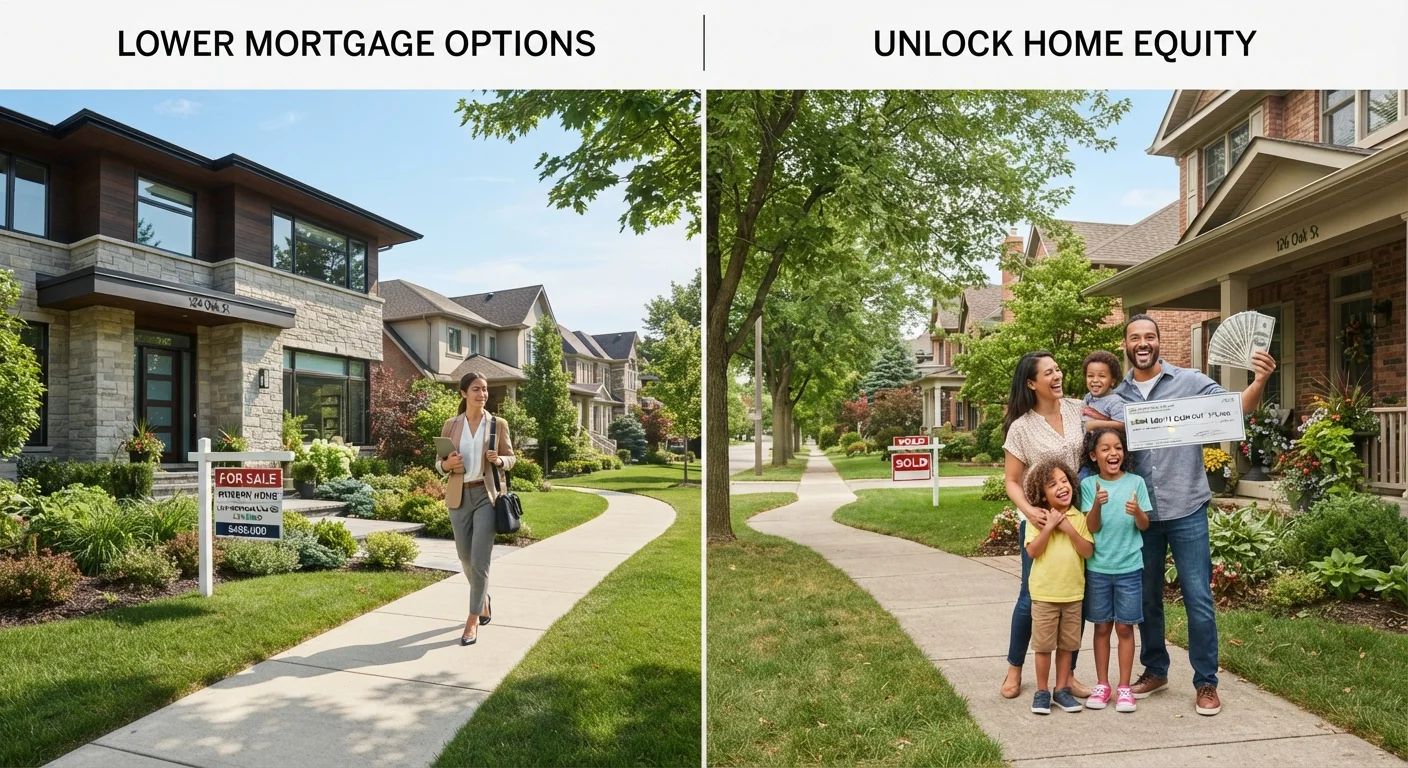
What Both Types of Refinancing Have in Common
When you refinance a mortgage, you're replacing your existing home loan with a new one. Whether you pursue rate-and-term or cash-out refinancing, several things stay consistent: you'll apply with a lender, go through underwriting, and pay closing costs — typically 2% to 5% of the loan amount. The new loan will also restart your repayment clock, which matters if you're years into your current mortgage.
Understanding the shared mechanics helps clarify what separates the two. For a broader grounding in mortgage terminology, see our mortgage glossary for first-time buyers, which covers concepts like loan-to-value ratio (LTV) and amortization that apply to both refinance types.
| Criterion | Rate-and-Term Refinance | Cash-Out Refinance |
|---|---|---|
| Primary goal | Lower rate or change term | Access home equity as cash |
| Loan balance after closing | Stays roughly the same | Increases by the cash received |
| Typical interest rate | Lower (less lender risk) | Slightly higher (more lender risk) |
| Equity requirement | Varies; generally flexible | Usually must retain 20% equity |
| Closing costs | 2%–5% of loan amount | 2%–5% of loan amount |
| Lender scrutiny | Standard underwriting | Stricter; higher credit score often required |
| Monthly payment impact | Often decreases | Typically increases |
| Best suits | Cost-reduction goals | Large planned expenses |
Rate-and-Term Refinancing: Restructuring Without Borrowing More
Rate-and-term refinancing is exactly what its name suggests: you change the interest rate, the loan term, or both. Your new loan pays off your existing mortgage, and the principal balance stays roughly the same — you aren't pulling out any extra cash.
Common motivations include:
- Lowering the interest rate to reduce monthly payments and total interest paid over time
- Shortening the loan term — for example, moving from a 30-year to a 15-year mortgage — to build equity faster and pay less interest overall
- Switching loan structure, such as moving from an adjustable-rate to a fixed-rate mortgage for payment predictability
For context on rate structures, our article on fixed-rate vs. adjustable-rate mortgages explains how each type affects your budget over time. Families focused on paying down their mortgage faster may also find value in mortgage payoff strategies that complement a term-shortening refinance.
2%–5%
Typical closing cost range for any refinance
The Consumer Financial Protection Bureau (CFPB) notes that refinance closing costs generally fall between 2% and 5% of the loan amount, making break-even analysis essential.
80%
Maximum LTV typically allowed for cash-out refinance
Most conventional lenders cap cash-out refinancing at 80% loan-to-value, meaning homeowners must retain at least 20% equity after the transaction.
~2+ years
Typical time needed to break even on refinance costs
Financial planners commonly advise calculating a break-even period by dividing closing costs by monthly savings to determine if staying in the home long enough makes refinancing worthwhile.
Cash-Out Refinancing: Converting Equity Into Funds
Cash-out refinancing works differently. You borrow more than your current mortgage balance, the old loan is paid off, and you receive the difference in cash at closing. For example, if your home is worth $350,000 and you owe $200,000, a lender might allow you to refinance for $270,000 — giving you roughly $70,000 in cash (before closing costs), while your loan balance increases.
Lenders generally require that you retain at least 20% equity in the home after the cash-out, meaning your new loan cannot exceed about 80% of the home's appraised value. Requirements vary by lender and loan type.
Typical reasons homeowners pursue cash-out refinancing include funding significant home improvements, covering educational expenses, or consolidating higher-interest debt. Because the loan balance is larger and the lender takes on more risk, interest rates on cash-out refinances are generally slightly higher than on rate-and-term refinances.
Your Home Is Collateral — In Both Cases
With cash-out refinancing, you're converting home equity into debt secured by the property itself. If financial circumstances change and payments become difficult, the home is at risk. This is a meaningful distinction from unsecured borrowing options. Rate-and-term refinancing carries the same underlying collateral risk, but doesn't increase the amount owed. Weigh this carefully, and speak with a licensed financial professional before proceeding.
For a complete overview of when either type of refinancing is worth the cost, our companion article on mortgage refinancing decisions walks through the full picture.
How to Think Through the Decision
The clearest guide is your goal. Ask yourself: Am I trying to reduce what my loan costs me each month or over time, or do I need access to funds my home equity represents? If the answer is the former, rate-and-term refinancing is the relevant path to explore. If the latter, cash-out refinancing enters the picture — though it requires honest assessment of the added risk of a larger mortgage balance secured by your home.
Also factor in how long you plan to stay in the home. Closing costs mean refinancing has an upfront price tag; you generally need enough time in the property to recoup that cost through lower payments or other benefits. Our guide to home loan types can also help you understand whether your current loan type affects which refinance options are available to you.
This article is for general informational and educational purposes only and does not constitute personalized financial, mortgage, or legal advice. Loan terms, eligibility, and costs vary by lender, loan type, and individual circumstances. Always consult a licensed mortgage professional or qualified financial adviser before making decisions about refinancing your home loan.