
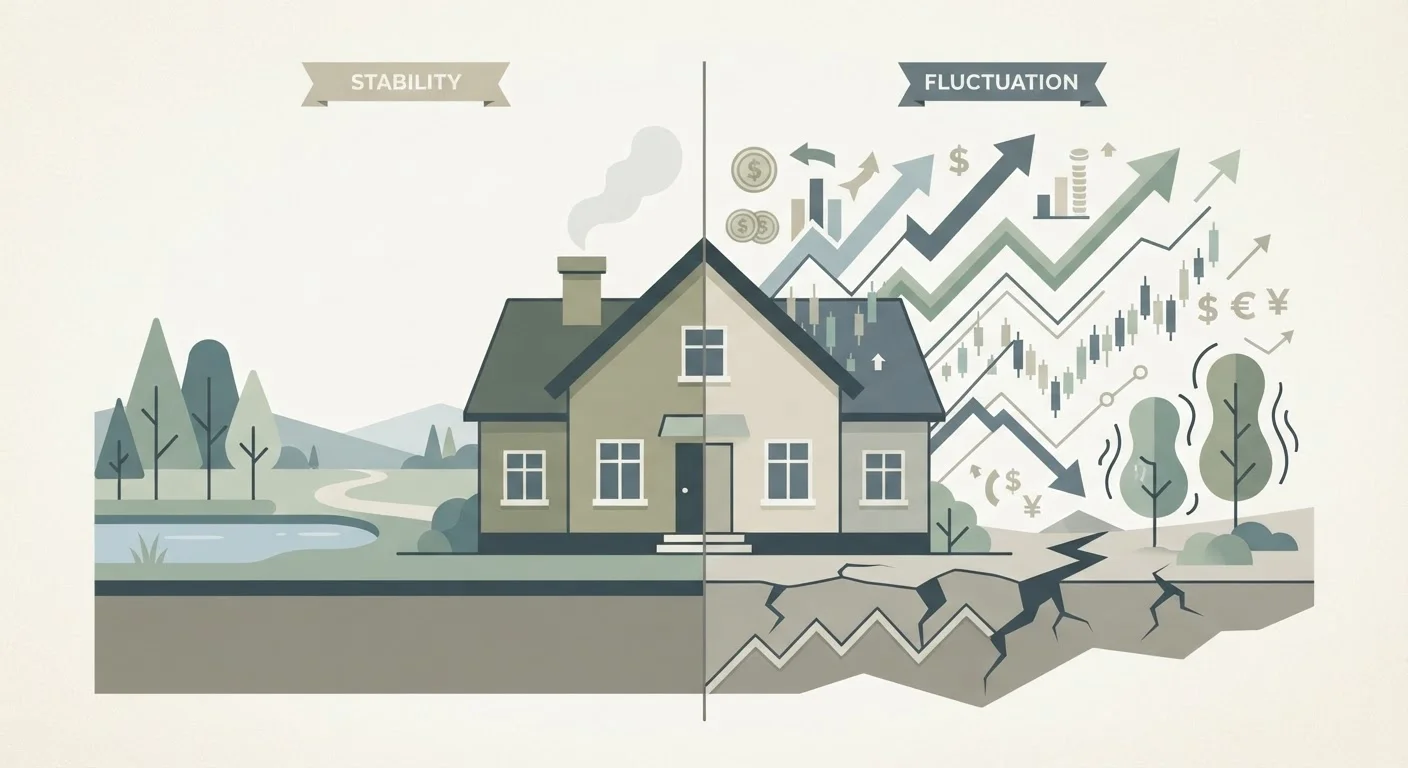
The Core Structural Difference
At their foundation, fixed-rate and adjustable-rate mortgages differ in one key way: when and whether your interest rate can change.
With a fixed-rate mortgage, the interest rate is set at closing and remains the same for the entire loan term — commonly 15 or 30 years. Your principal-and-interest payment never changes, regardless of what happens in financial markets. (Note: your total monthly payment can still shift if property taxes or homeowners insurance costs change — see what makes up your full mortgage payment for more on that.)
With an adjustable-rate mortgage (ARM), the rate is fixed only during an initial introductory period — often 3, 5, 7, or 10 years. After that, it adjusts at regular intervals (typically once a year) based on a benchmark interest rate index, such as the Secured Overnight Financing Rate (SOFR). The most common ARM format you'll see is written as two numbers, like 5/1 — meaning the rate is fixed for 5 years, then adjusts every 1 year afterward.
| Criterion | Fixed-Rate Mortgage | Adjustable-Rate Mortgage (ARM) |
|---|---|---|
| Interest rate over time | Stays the same for the full loan term | Fixed initially, then adjusts periodically |
| Initial rate level | Typically higher at origination | Typically lower during introductory period |
| Payment predictability | Principal & interest never change | Can rise or fall after fixed period ends |
| Rate caps | Not applicable | Initial, periodic, and lifetime caps apply |
| Best ownership horizon | Long-term (10+ years) | Shorter-term (plan to move or refinance) |
| Risk profile | Lower payment risk | Higher payment uncertainty after intro period |
| Common loan terms | 15-year, 30-year | 5/1, 7/1, 10/1 ARM structures |
This structural difference has real consequences for your household budget planning, particularly if your income doesn't flex easily with market movements.
How ARMs Work After the Introductory Period
The adjustment mechanism is what many first-time borrowers don't fully understand before signing. When an ARM's fixed period ends, your lender recalculates your rate by adding a margin (a fixed number set in your loan contract) to a benchmark index (a market rate that moves with economic conditions). The result becomes your new interest rate for that adjustment period.
Most ARMs include built-in safeguards called rate caps, which limit how much your rate can change:
- Initial cap: The maximum increase allowed at the first adjustment (often 2–5 percentage points).
- Periodic cap: The maximum increase per adjustment after the first (often 1–2 percentage points).
- Lifetime cap: The maximum total increase over the life of the loan (often 5–6 percentage points above your starting rate).
These caps provide some protection, but even a 2-point rate increase on a $350,000 loan balance can add hundreds of dollars to a monthly payment. Understanding how rate changes affect variable-rate debt in real dollar terms is an important step before choosing an ARM.
5–6 pts
Typical ARM lifetime rate cap above starting rate
Most ARM loan contracts limit total rate increases to 5–6 percentage points above the initial rate over the life of the loan, according to standard U.S. mortgage disclosure practices.
~90%
Share of U.S. mortgages that are fixed-rate
Fixed-rate mortgages have historically dominated the U.S. market; ARM share tends to rise when fixed rates are elevated and borrowers seek lower entry payments.
0.5–1.5 pts
Typical initial rate gap between fixed and ARM
ARMs commonly start at rates roughly 0.5 to 1.5 percentage points below comparable fixed-rate loans, though the actual spread varies with market conditions.
What Each Option Costs You Over Time
Fixed-rate mortgages typically carry higher initial interest rates than ARMs at the time of origination. That difference — sometimes 0.5 to 1.5 percentage points, depending on market conditions — means ARM borrowers often enjoy lower monthly payments during the introductory period.
Whether that short-term saving outweighs the long-term risk depends heavily on how long you stay in the home and where rates move. If you sell before the ARM adjusts, you may come out ahead. If you stay and rates rise sharply, you could end up paying significantly more than you would have with a fixed loan.
It's worth running a break-even comparison: calculate the total interest you'd pay under each scenario over your expected ownership horizon. A housing counselor or licensed mortgage professional can help model these numbers for your specific situation. This article is for general informational purposes and does not constitute personalized financial advice.
If your circumstances change later — for instance, if you want to switch from an ARM to a fixed-rate structure — refinancing may be an option worth exploring, though it comes with its own costs and qualifications.
ARMs Are Not Inherently Risky — Context Matters
Adjustable-rate mortgages gained a negative reputation following the 2008 financial crisis, when certain ARM products had few consumer protections. Today, federally regulated ARMs must include rate caps and clear disclosure requirements. That said, an ARM is still a product that requires careful evaluation of your timeline, income stability, and risk tolerance. Always read your loan estimate and ask your lender to walk through the worst-case adjustment scenario before you commit.
Choosing Based on Your Situation, Not Just the Rate
The temptation to choose whichever option has the lower number on paper is understandable — but it's rarely the complete picture. A few questions worth thinking through:
- How long do you plan to stay? If you're confident you'll move or refinance within the ARM's fixed period, the higher certainty of a fixed rate may be unnecessary. If you're planting roots, fixed is typically easier to plan around.
- How stable is your income? Borrowers with reliable, growing income are generally better positioned to absorb an ARM adjustment. Those on fixed incomes or tight budgets have less buffer if payments rise.
- What is your overall financial cushion? An emergency fund and low existing debt give you more flexibility to weather rate changes without financial strain.
It's also useful to separate this decision from the separate (but related) question of loan term. Comparing a 15-year vs. 30-year mortgage involves different trade-offs around total interest paid and monthly payment size — and that choice applies to both fixed and adjustable loan types. Likewise, clearing up common mortgage myths before you apply can help you walk into the process with realistic expectations.
This article is for general informational and educational purposes only and does not constitute personalized financial or mortgage advice. Consult a licensed mortgage professional or financial adviser to evaluate options based on your individual circumstances.