
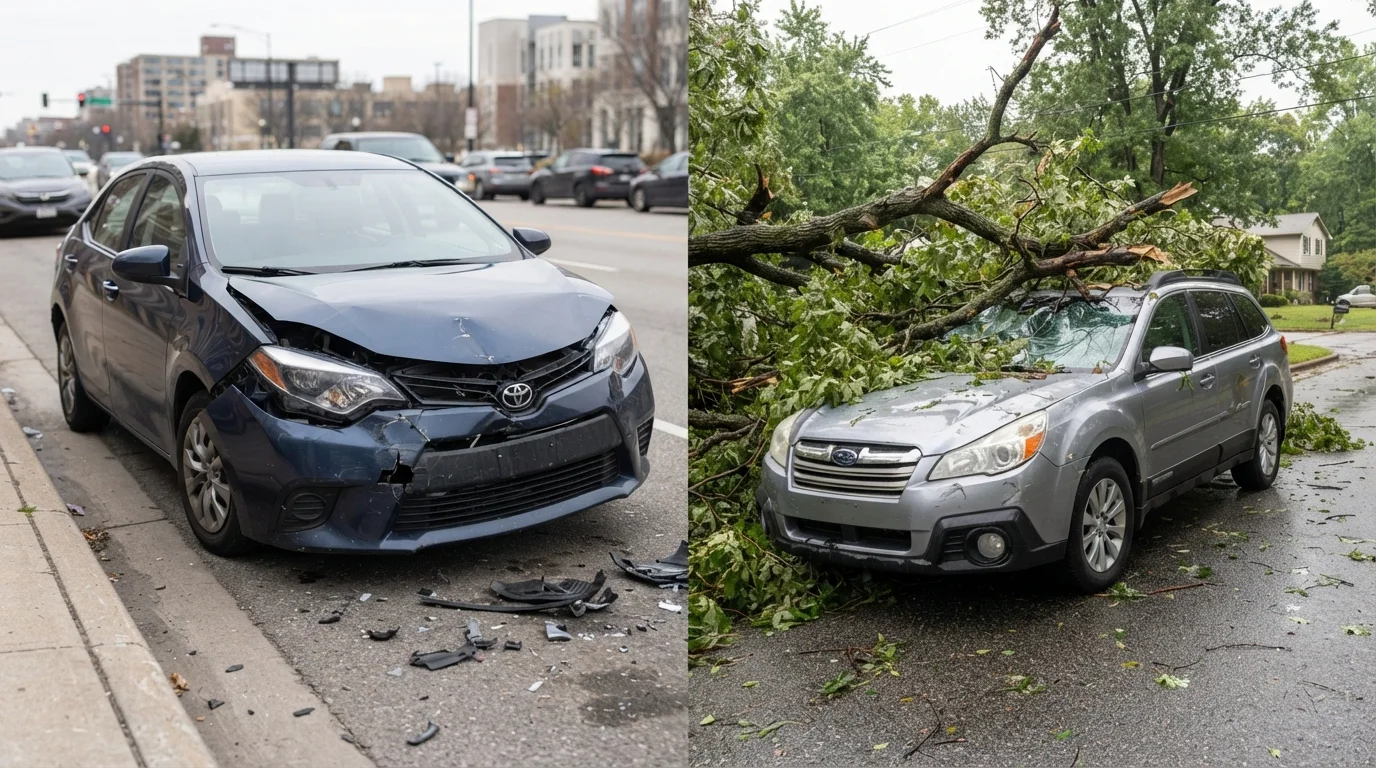
What Each Coverage Actually Does
When you're reading an auto insurance policy for the first time, the names "collision" and "comprehensive" can blur together. Both protect your vehicle from physical damage, and both are sometimes called "physical damage coverage" — but they respond to completely different types of events.
Collision coverage pays to repair or replace your vehicle when it is damaged in a crash. That includes hitting another car, running into a guardrail, or rolling over. Crucially, fault generally doesn't matter — your collision coverage can apply even when you caused the accident.
Comprehensive coverage (sometimes called "other than collision") pays for damage caused by events that are not crashes. Common examples include theft, vandalism, hail, flooding, fire, falling objects, and collisions with animals such as deer. If a tree limb drops onto your parked car during a storm, that is a comprehensive claim — not a collision claim.
For a fuller look at how auto insurance terms fit together, see Car Insurance Basics Every Vehicle Owner Should Understand.
| Criterion | Collision Coverage | Comprehensive Coverage |
|---|---|---|
| What triggers a claim | Vehicle hits or is hit by another object or vehicle | Non-collision events: theft, weather, fire, animals |
| Fault requirement | Not required — covers regardless of fault | Not applicable — events are generally uncontrollable |
| Typical deductible range | $250–$1,500 | $100–$1,000 |
| Payout basis | Actual cash value of the vehicle | Actual cash value of the vehicle |
| Required by law | No — optional unless lender requires it | No — optional unless lender requires it |
| Common example | Rear-ending another car at a stop light | Hail storm dents roof and hood |
Deductibles, Limits, and How Payouts Work
Each coverage carries its own deductible — the amount you pay out of pocket before the insurer covers the rest. Collision deductibles are commonly set between $250 and $1,500; comprehensive deductibles are often lower, sometimes as little as $100, because comprehensive claims are generally less frequent and less predictable.
Once your deductible is satisfied, the insurer pays up to the actual cash value (ACV) of your vehicle — its market value at the time of the loss, accounting for depreciation. This is an important distinction: neither collision nor comprehensive pays the price you originally paid for the car, nor does it pay what it would cost to buy a comparable new vehicle today. Understanding how ACV differs from replacement cost is worth exploring further: Actual Cash Value vs. Replacement Cost: How Your Payout Is Calculated.
~75%
Insured drivers carrying comprehensive coverage
According to the Insurance Information Institute, roughly three-quarters of insured US drivers carry comprehensive coverage, making it one of the more commonly purchased optional coverages.
~72%
Insured drivers carrying collision coverage
The Insurance Information Institute also reports that a similar share of insured drivers add collision to their policies, reflecting how frequently lenders require it for financed vehicles.
Choosing a higher deductible lowers your premium but increases your financial exposure at claim time. There is no universally correct deductible — it depends on how much risk you are comfortable carrying and how much cash you could access quickly after a loss.
When Each Coverage Applies: Common Scenarios
Knowing which coverage to invoke at claim time prevents delays and confusion. Here are typical real-world situations and which policy responds:
- You rear-end another driver → Collision
- A driver rear-ends your parked car and flees → Collision (your own policy, since the at-fault driver is unidentified)
- A deer runs into the side of your vehicle → Comprehensive
- Your car is stolen from your driveway → Comprehensive
- Hail dents your hood and roof → Comprehensive
- You hydroplane and hit a curb → Collision
- A fire damages your engine compartment → Comprehensive
The defining question is simple: Did a collision cause the damage? If yes, collision coverage applies. If the damage came from a hazard unrelated to driving into something, comprehensive is the right category.
When a Single Incident Involves Both Coverages
In rare situations, one event could theoretically involve both coverage types — for example, if you swerve to avoid a deer, miss it, and hit a guardrail instead. In that case, collision coverage would apply because the resulting damage came from striking an object, not from the animal itself. Insurers look at the proximate (direct) cause of the damage, not the chain of events that led to it. When you are unsure which coverage applies, contact your insurer before filing — they can help you route the claim correctly.
If you are also evaluating how your overall auto and home policies interact, Bundling Home and Auto Insurance: Trade-Offs Worth Understanding explores how combining policies with one insurer can affect your overall coverage picture.
Deciding Whether to Carry One, Both, or Neither
Neither collision nor comprehensive is legally required by any US state — state minimums only mandate liability coverage. However, if your vehicle is financed or leased, your lender almost certainly requires both as a condition of the loan or lease agreement.
If you own your vehicle outright, the decision comes down to the vehicle's current market value relative to what you would pay in premiums and deductibles over time. A general guideline: if your annual premium for a coverage type, plus its deductible, approaches or exceeds your vehicle's value, you may be paying more than you'd recover. That said, this is a general consideration, not a guarantee of outcome — individual circumstances vary widely.
When comparing policies, it pays to look beyond the premium alone. Shopping for Home and Auto Insurance: What to Compare Beyond the Premium lays out a practical framework for evaluating deductibles, exclusions, and claims service side by side.
This article is for general informational and educational purposes only and does not constitute personalised insurance, financial, or legal advice. Coverage terms, exclusions, and costs vary by insurer and state. Always read your actual policy documents and consult a licensed insurance agent or adviser for guidance specific to your situation.