
Why Retailers Don't Price Items Randomly
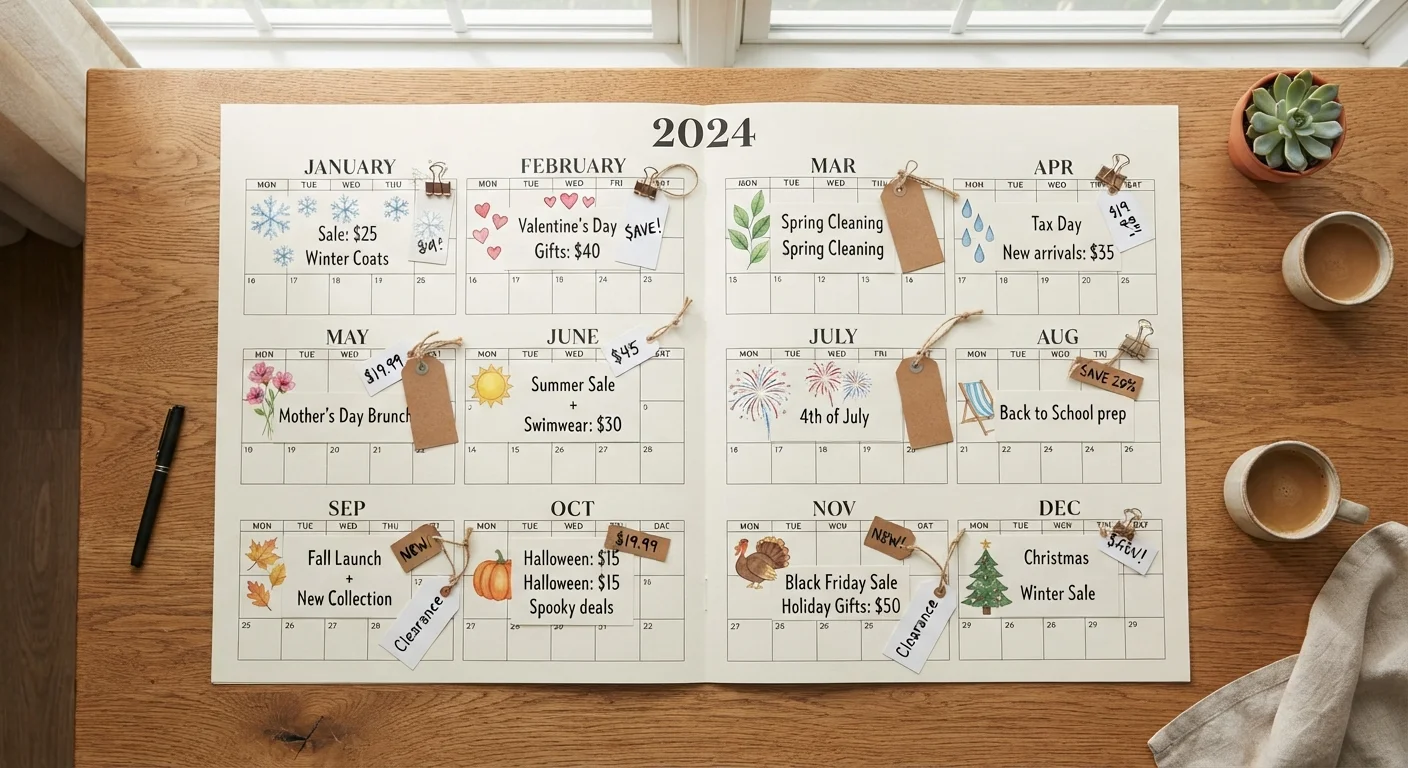
Every price tag you see in a store or online is the result of deliberate planning. Retailers build detailed promotional calendars months — sometimes over a year — in advance. These plans account for when customers are most likely to buy, when suppliers are shipping new inventory, and when the company needs to hit revenue targets.
The core dynamic is simple: price reflects demand. When shoppers are actively looking for a product — think toys in December or luggage before summer travel season — retailers hold prices steady because there's no incentive to discount. When demand falls or new stock needs shelf space, markdowns follow.
This isn't guesswork on the retailer's part. It's a structured system, and once you understand it, you're working with the same information their buyers use. See our explanation of how retail sales cycles actually work for a deeper look at the mechanics behind store discounting.
4–6 weeks
Typical post-holiday clearance window
Retail analysts generally observe that post-holiday markdowns begin in late December and run through late January, varying by category and retailer.
30–70%
Common end-of-season markdown range
End-of-season clearance discounts across apparel and seasonal goods typically fall in this range, though actual savings vary widely by retailer and product.
The Four Pricing Phases Every Shopper Should Know
Most retail categories move through four recurring phases each year:
- Peak pricing: Items are priced at or near full retail during periods of high seasonal demand. Back-to-school supplies in August, winter coats in November, and grills in May are examples.
- Promotional windows: Retailers offer targeted discounts around specific shopping events — major sale holidays, manufacturer promotions, or limited-time events tied to a specific category.
- End-of-season markdowns: As demand fades and new inventory approaches, retailers reduce prices to clear stock. This is often when the steepest discounts appear.
- Clearance: The final phase, where remaining units are heavily discounted. Selection is limited, but prices are typically at their lowest.
Families who understand these phases can position themselves to buy during Phase 3 or 4 for items they can plan in advance, while accepting Phase 1 pricing only when a purchase is truly urgent.
Build a Simple 'Wishlist' to Track Planned Purchases
Keep a running list of items your household expects to need in the next 6–12 months. Even a basic notes app or a piece of paper on the fridge works. When you know a category's typical markdown window is coming, you'll be positioned to act instead of scrambling. This one habit is the foundation of seasonal shopping strategy.
How the Calendar Varies by Product Category
One of the most useful things to know is that each product category runs its own version of the retail calendar. Appliances don't follow the same cycle as children's clothing, and electronics behave differently from outdoor furniture.
A few broadly observed patterns worth knowing:
- Apparel: Transitions between seasons — late January, late July — are when clothing retailers move prior-season inventory aggressively.
- Electronics: The period around major November shopping events and post-holiday January tend to bring lower prices on consumer electronics.
- Home furnishings: Late summer and post-holiday winter are common markdown windows for furniture and décor.
- Outdoor and seasonal equipment: The end of the season of use — late summer for lawn equipment, late winter for snow gear — typically yields the deepest discounts.
For a month-by-month breakdown of which categories tend to discount when, the family shopping calendar is a useful reference to keep handy.
Turning Calendar Knowledge Into a Household Strategy
Understanding the retail calendar is only useful if it changes how you shop. The practical shift is moving from reactive buying — purchasing something when you need it — to planned buying — purchasing something before you need it, when pricing is favorable.
This doesn't require complex tracking. A simple list of anticipated household purchases for the next six to twelve months, matched against the general category cycles above, is enough to identify where waiting makes sense.
For families newer to this approach, getting started with seasonal shopping walks through the foundational habits, and building a household purchase plan shows how to structure the process in a practical way. If you want to incorporate this into broader household budgeting, the home budgeting hub covers how to align purchase timing with your overall financial picture.
The core principle is the same regardless of approach: the more purchases you can anticipate, the more choices you have about when to buy.