
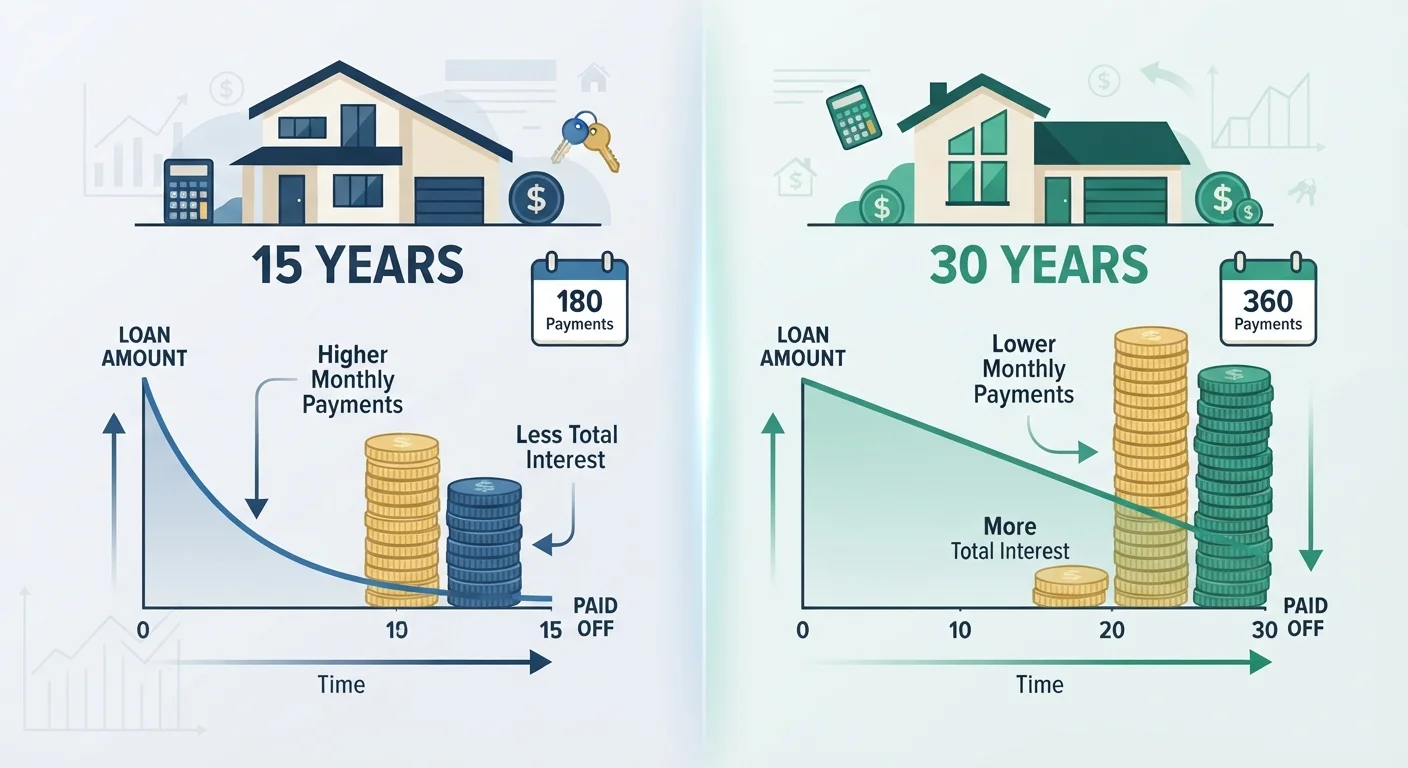
What the Numbers Actually Look Like
The clearest way to understand the trade-off is to look at a concrete example. Imagine a $350,000 home loan. At a hypothetical fixed rate of 6.5% for a 30-year term versus 6.0% for a 15-year term (shorter-term loans often carry a modestly lower rate), here is how the math shakes out:
| Criterion | 15-Year Mortgage | 30-Year Mortgage |
|---|---|---|
| Typical interest rate | Generally lower | Generally higher |
| Monthly payment (illustrative) | Higher (~$2,950) | Lower (~$2,212) |
| Total interest paid (illustrative) | Lower (~$181,000) | Higher (~$347,000) |
| Equity build-up speed | Faster | Slower |
| Monthly cash-flow flexibility | Less flexible | More flexible |
| Loan payoff timeline | 15 years | 30 years |
| Best for income stability | Requires stable, higher income | More forgiving of variable income |
The monthly payment difference — roughly $700 to $900 in this example — is the central tension. That gap is real money each month. But so is the roughly $150,000 or more in additional total interest a borrower pays by choosing the longer term. Neither fact cancels out the other; they simply reflect different priorities.
To understand why the interest gap is so large, it helps to know how amortization works. Learn how amortization shapes what you actually pay over a loan's life — early payments are weighted heavily toward interest, meaning equity builds slowly at first on a 30-year schedule.
The Cash-Flow Argument for the 30-Year
For many American families, the 30-year mortgage is not just a preference — it is a practical necessity. A lower required monthly payment can mean the difference between qualifying for a loan and not, or between covering an unexpected repair bill and missing one.
Cash-flow flexibility matters especially when a household carries other obligations: student loans, car payments, childcare costs, or medical expenses. A mortgage payment that stretches a budget to its limit leaves little room for anything to go wrong.
~$135K+
Additional interest on a 30-year vs. 15-year loan
Illustrative estimate based on a $350,000 loan comparing a 6.0% 15-year and 6.5% 30-year fixed rate; actual figures vary by rate and loan amount.
~$700–$900
Typical monthly payment difference between loan terms
Approximate difference for a $350,000 loan at the example rates above; real payment gaps depend on your specific loan terms and lender.
~30%
Share of early 30-year payments applied to principal
In the early years of a standard 30-year amortization schedule, a relatively small portion of each payment reduces the loan balance.
Some households deliberately choose the 30-year term and then make extra principal payments in the months when cash allows. This approach retains flexibility while still reducing total interest over time. Explore strategies families use to pay off a mortgage faster if this hybrid approach interests you — though there is no obligation to pay extra, and individual results vary.
It is worth noting that a similar dynamic appears in other consumer debt. What families often get wrong about car loan terms explores how low monthly payments on longer loans can obscure higher total costs — a parallel worth keeping in mind.
The Equity and Rate Argument for the 15-Year
The 15-year mortgage has two structural advantages that compound over time: a lower interest rate and a faster equity build-up. Because lenders face less repayment risk over a shorter window, they typically offer lower rates on 15-year loans. That rate difference, even if modest, reduces both the monthly payment and the total interest accrued.
Equity — the share of your home's value that you own outright — grows faster with a 15-year loan because a larger portion of each payment reduces the principal balance. A homeowner who plans to sell within 10 to 15 years or who wants to refinance may find this advantage meaningful. When it comes time to sell or tap home equity, a larger equity cushion provides more financial options.
Rate Differences Can Shift Over Time
The gap between 15-year and 30-year mortgage rates fluctuates with broader market conditions. Historically, 15-year rates have run roughly 0.5 to 0.75 percentage points below 30-year rates, but this spread can be narrower or wider at any given time. Always compare current rate quotes from multiple lenders before drawing conclusions about which term is more economical in your specific situation.
For households weighing whether a rate change might ever prompt a switch to a different loan structure, understanding fixed-rate versus adjustable-rate mortgages provides helpful context on how rate types interact with loan terms.
If your circumstances change — income rises, financial goals shift — refinancing into a shorter term is one path borrowers use to capture some of the 15-year advantages later. Refinancing involves its own costs and considerations, so it is not a guaranteed improvement.
This article is for general informational purposes only and does not constitute personalized financial or mortgage advice. Consult a qualified financial adviser or licensed mortgage professional before making decisions based on your individual circumstances.