
How Each Channel Surfaces Discounts Differently
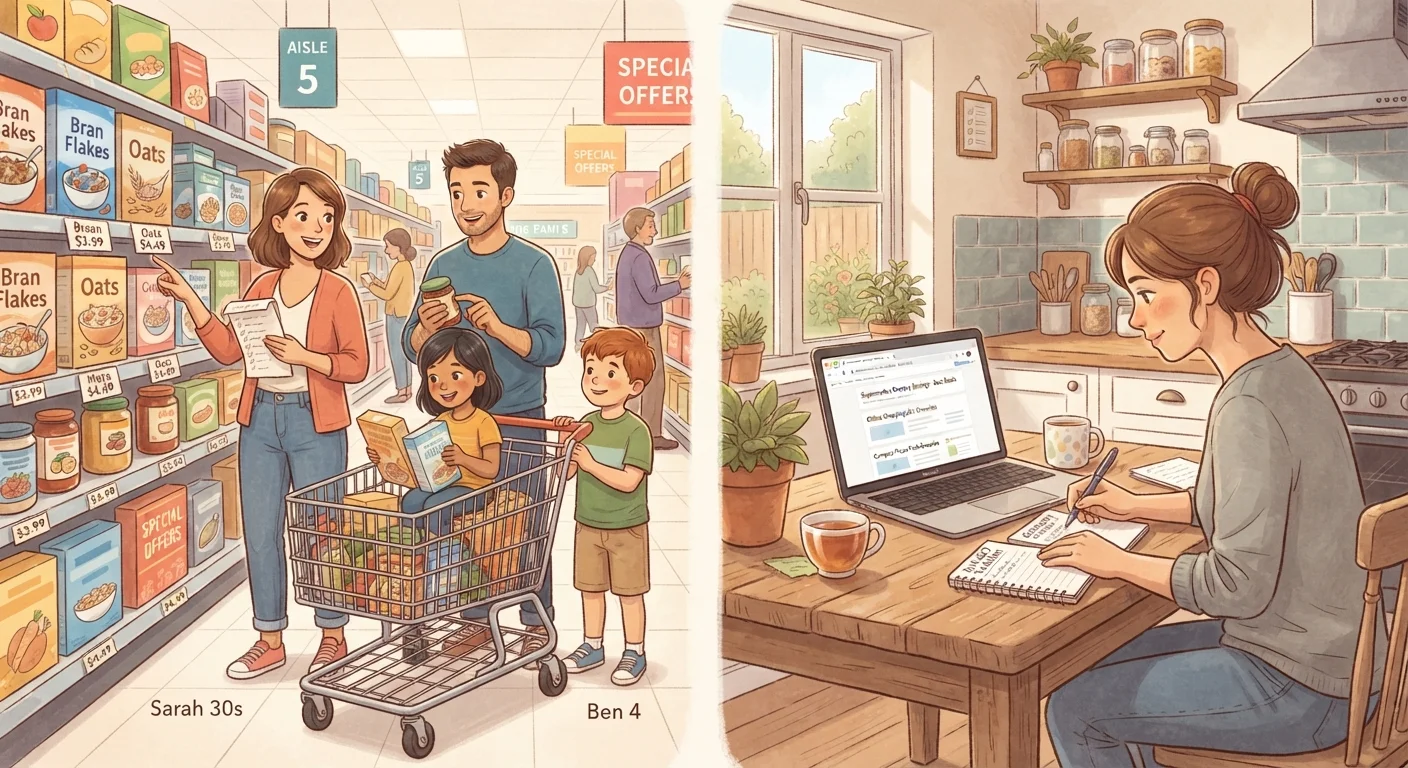
In-store and online retailers discount inventory for different operational reasons, and that shapes the kinds of deals each channel tends to produce. Physical stores need to move shelf space — so clearance racks, manager markdowns on near-expiry goods, and end-of-aisle promotions reflect real logistics pressure. Online retailers, by contrast, compete on visibility: their discounts are designed to be searchable, stackable with promo codes, and triggered by shopping behavior like cart abandonment.
Understanding this distinction helps families stop assuming that one channel is automatically cheaper. The actual savings depend on the category, the timing, and how much effort you're willing to put in. For a broader breakdown of how to spot value across spending categories, see this complete family guide to finding deals.
| In-Store | Online | |
|---|---|---|
| Clearance & Markdowns | Strong — physical shelf pressure drives deep cuts | Limited — clearance often excluded from sites |
| Price Comparison Speed | Slow — requires travel between stores | Fast — multiple retailers in seconds |
| Coupon & Cashback Stacking | Limited — paper or app coupons only | Strong — codes, portals, and card rewards combinable |
| Impulse Spending Risk | Higher — physical browsing increases unplanned buys | Moderate — algorithms and flash sales add pressure |
| Price Matching Opportunity | Common — ask at checkout | Rare — most policies apply in-store only |
| Shipping / Return Friction | None — take it home immediately | Variable — fees can offset discounts |
| Perishables & Groceries | Practical — see and select fresh items | Improving, but quality control varies |
Where In-Store Shopping Has the Edge
Physical stores still have meaningful advantages for certain shopping situations. Clearance sections — especially at the end of a season — often carry deeper markdowns than anything listed online. These items are frequently excluded from retailer websites entirely, or listed as "in-store only." Grocery shoppers in particular often find unadvertised weekly specials and meat-counter markdowns that never appear in any app.
In-store shopping also gives families a concrete advantage when it comes to price matching. Many large retailers will match a competitor's current price if you ask at checkout. Price matching policies vary widely, but the opportunity exists in the store in a way it rarely does online. Finally, there's no shipping cost or delivery window to factor in — you leave with what you paid for.
Ask About Unadvertised In-Store Specials
Not every markdown makes it onto the weekly flyer or the store's website. A quick question to a department associate — especially in grocery, clothing, or home goods — can surface markdowns that aren't posted. End-of-day perishables and end-of-season rack clearances are two areas where unposted discounts are most common.
Where Online Shopping Has the Edge
Online shopping's clearest advantage is comparison speed. In the time it takes to drive to a second store, you can check the same item across a dozen retailers without leaving your chair. This makes it significantly easier to identify whether a "sale" price is genuinely below normal market levels or just dressed-up regular pricing.
Online channels also allow savings to be layered in ways that aren't possible in stores. A shopper can apply a promo code, activate a cashback portal, and use a rewards credit card simultaneously — combining multiple discount mechanisms on a single purchase. Coupons, promo codes, and cashback all work differently, but online is generally where stacking them is most practical. That said, shipping fees and return friction can erode those gains, so the math isn't always straightforward.
The Hidden Costs Each Channel Carries
Both channels have costs that don't show up in the sticker price. In-store shopping costs time — travel, parking, and the cognitive load of navigating a physical space. It also increases exposure to impulse purchases. Research on retail behavior consistently shows that shoppers spend more per trip when browsing in person than when following a fixed online list.
Online shopping's hidden costs are different: shipping fees, the temptation of flash sales and countdown timers, and return hassle when items don't fit or match expectations. Families who shop online for clothing or furniture often absorb return shipping costs that quietly offset the original discount. Being aware of these friction points — for both channels — is foundational to building a smart shopping approach from scratch.
Watch for Inflated 'Original' Prices Online
Some online retailers set artificially high reference prices to make a discount appear larger than it is. Before treating a percentage-off figure as meaningful, check what the item has actually sold for over recent weeks using a price-history tool. A "40% off" badge loses its appeal if the item was marked up before the sale began.
Building a Routine That Uses Both Channels Strategically
The families who consistently stretch their household budgets furthest tend not to be loyal to one channel. They use each for what it does well: in-store for fresh food, seasonal clearance, and price-matched staples; online for researching larger purchases, stacking discount mechanisms, and buying non-urgent items when prices dip. You can also align your approach with predictable retail patterns — in-store and online promotions follow different seasonal rhythms, and timing your channel choice accordingly adds another layer of value.
If you want to formalize this into a system that doesn't consume your weekends, a structured deal-hunting routine can help you apply both approaches without it becoming a second job.