
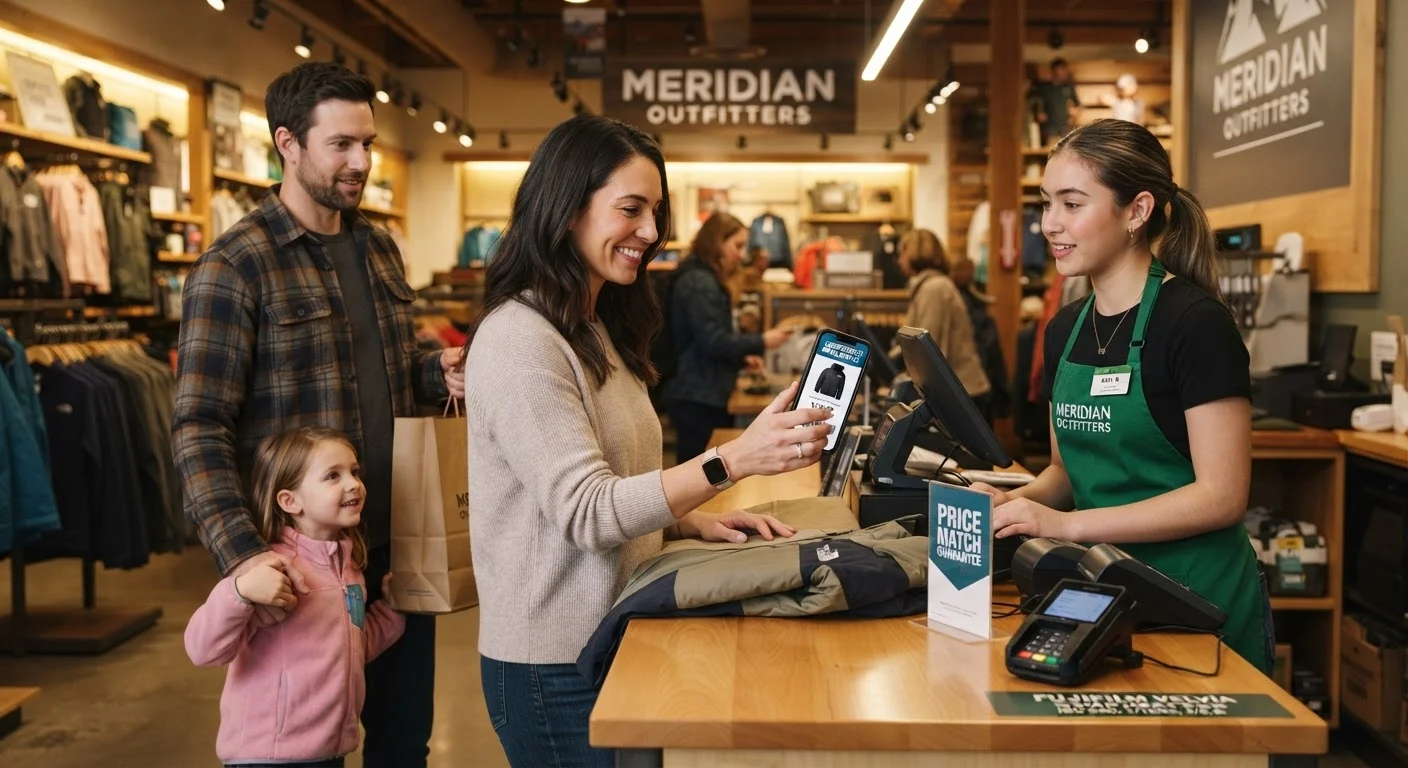
How Price Matching Actually Works
The basic mechanic is straightforward: you find the same item listed for less at a qualifying competitor, bring that evidence to the retailer, and ask them to match it. If the request meets their criteria, they adjust the price before you complete your purchase — no coupons, no rebate forms, no second trip.
In practice, the process involves a few moving parts. First, the items must be genuinely identical — same brand, model number, color, size, and condition (new vs. refurbished). Second, the competitor must be one the retailer recognizes as eligible under its policy. Third, the lower price must be currently available, meaning the competitor has the item in stock at that price right now.
If all three conditions are met, the associate typically adjusts your total at the register. Some retailers handle requests through customer service desks or online chat for web orders. Either way, it's worth being polite and prepared — having the competitor's listing pulled up on your phone makes the process faster for everyone.
Prepare Before You Reach the Register
Before heading to the store, search the item online to check current prices at a few comparable retailers. Have the competitor's listing ready on your phone — ideally with the item name, model number, and price visible. The faster you can show the associate what you found, the smoother the process goes.
What Varies Between Retailer Policies
This is where families need to pay close attention. There is no universal standard for price matching — each retailer writes its own rules, and the differences can be significant.
36+
Major US retailers with published price match policies
Consumer advocacy research consistently identifies dozens of large-format retailers — including general merchandise, electronics, and home improvement chains — that maintain formal price match programs.
~70%
Shoppers unaware their store matches prices
Surveys of US consumers have found that a significant majority are either unaware their preferred retailer has a price match policy or have never attempted to use one.
Which competitors count: Most policies list approved competitors. A hardware chain may match other hardware chains but not online-only retailers. A general merchandise store might match certain major websites but exclude marketplace sellers entirely.
Exclusions on item types: Bundle deals, open-box merchandise, refurbished products, clearance items, and limited-quantity promotions are commonly excluded. If a competitor is selling the last unit at a clearance price, that often won't qualify.
Timing windows: Some retailers will only match a price at the time of purchase. Others extend the window a few days before or after the sale, though that begins to overlap with price adjustment territory rather than price matching.
Understanding the retail pricing landscape more broadly — including how prices shift across seasons — can help you anticipate when price matching is likely to be most useful. See how the retail calendar drives price cycles for useful context.
Common Situations Where Price Matching Applies
Price matching tends to be most practical for mid-to-high-cost purchases where the price difference justifies the effort of finding and presenting proof. For a $10 item, the savings may not be worth the time. For a $300 appliance or electronics purchase, even a 10–15% gap can mean meaningful savings for a household budget.
Pairing price matching awareness with broader deal-finding habits helps. In-store and online deal-finding each work differently — knowing both approaches means you're more likely to spot a qualifying price difference in the first place.
How to Ask Without the Awkwardness
Many families skip price matching simply because they're unsure how to bring it up. The reality is that store associates field these requests regularly — it's a normal part of retail operations, not an unusual or difficult ask.
A simple, direct approach works well: "I found this item listed for at — does your store have a price match policy that would apply here?" This framing is polite, specific, and gives the associate what they need to evaluate the request quickly.
If the associate is unsure, ask to speak with a manager or customer service. Policies are sometimes inconsistently communicated at store level, and a supervisor will often have the authority to approve a match even when a front-line associate hesitates.
Keeping your household spending in check across categories — from shopping to larger financial decisions — is part of a broader budgeting strategy. Explore practical frameworks at home budgeting strategies for families.
“Retailers put price match policies in place to retain customers — they'd rather adjust a price than lose the sale entirely. Most shoppers simply don't know to ask.”
— Consumer Retail Research Analyst, Retail industry observer and pricing strategy researcher
Price Matching vs. Price Adjustments: A Quick Distinction
These two policies are easy to confuse, and mixing them up can lead to missed savings. Price matching happens at the point of purchase, based on what a competitor charges. A price adjustment — also called a post-purchase price protection — happens after you buy something, if the same retailer later lowers its own price within a defined window (commonly 7–30 days).
If you bought a refrigerator last week and the same store just put it on sale, a price adjustment is what you'd request. If you're standing at the register and want to match a lower price at a different retailer, that's price matching. Both are legitimate money-saving tools, but they apply at different moments and involve different policies.
For major purchases like appliances, understanding both policies before you buy can meaningfully reduce what you pay. Appliance pricing follows identifiable seasonal patterns — combining that timing knowledge with price match awareness is a practical approach for budget-conscious households.
Policies Change — Always Verify
Retailers revise their price match policies periodically, especially around major sale seasons. What was honored last year may have different conditions today. Before relying on a specific policy detail, check the retailer's current policy page or ask a store associate directly — don't assume last season's rules still apply.