
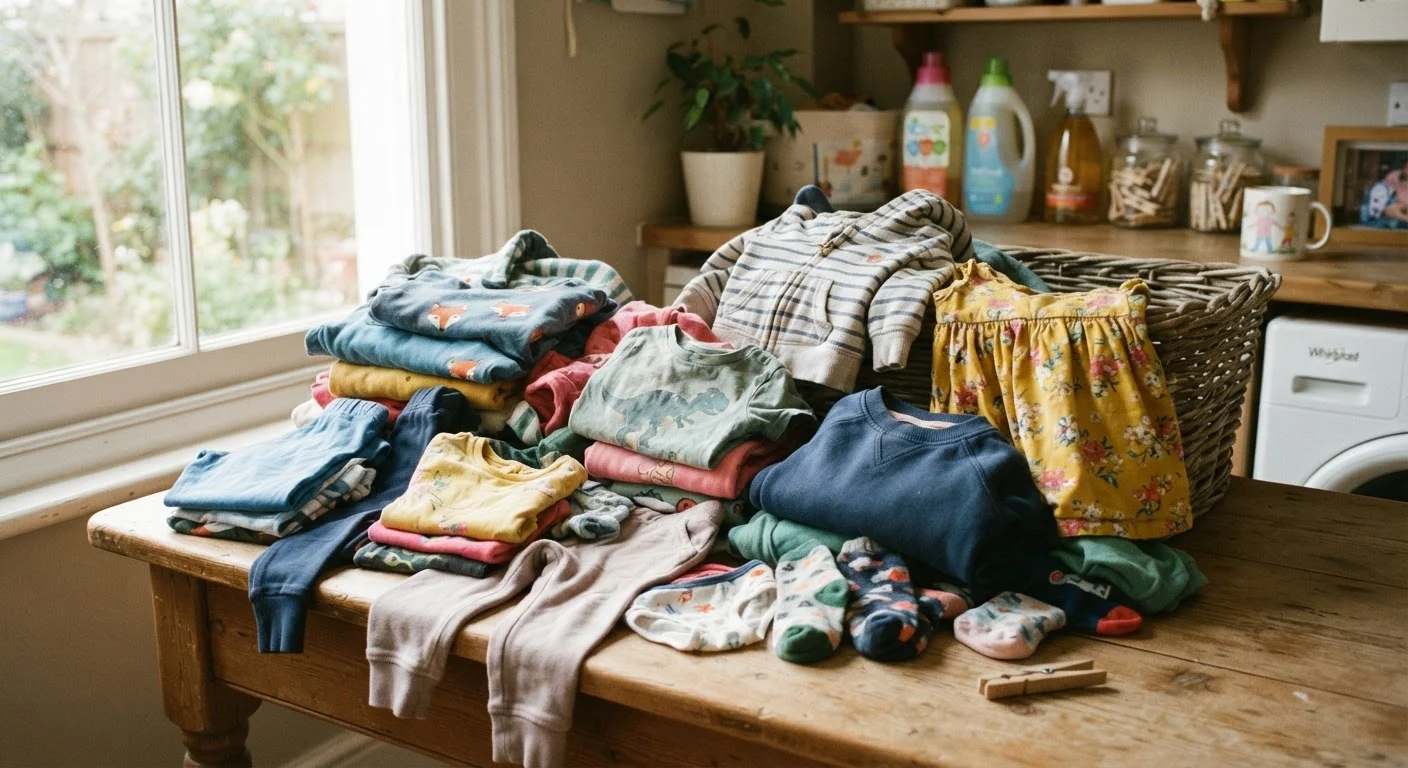
The Hidden Price of a Bargain
It feels like a win at checkout: a stack of kids' shirts for a few dollars each. But if those shirts pill after three washes, fade by month two, and fall apart before the season ends, that "deal" quietly becomes one of the pricier decisions you made all year. This is the trap that catches even the savviest family shoppers.
The concept of cost-per-wear — the total price of a garment divided by the number of times it's actually worn — reframes how we think about clothing value. A $6 shirt worn four times costs $1.50 per wear. A $20 shirt worn 40 times costs just $0.50 per wear. The math shifts the entire conversation away from the price tag and toward the question: how long will this actually last?
For families navigating a clothing budget, understanding what drives durability is the single most useful skill you can develop. It helps at thrift stores, at big-box retailers, and everywhere in between. Our guide on common family style pitfalls explores other habits that quietly drain clothing budgets too.
Myth
A lower price always means I'm saving money on kids' clothes.
Fact
Price at purchase and total cost are two different things — cheaper garments often cost more per wear due to faster deterioration.
Inexpensive clothing is often manufactured with cost-cutting measures: thinner fabrics, fewer stitches per inch, weaker dyes. These shortcuts show up fast in children's laundry, which tends to be frequent and heavy-duty. A garment that survives six months and 30 wears at $8 costs roughly $0.27 per wear — but if the garment only lasts 10 wears before seams split or colors bleed, the cost jumps to $0.80 per wear. Over a full wardrobe, that difference adds up significantly across a year.
Myth
Kids outgrow clothes so fast that quality doesn't matter.
Fact
Growth spurts are real, but many pieces are worn for six months to over a year — and durable ones can be passed to younger siblings or resold.
It's true that children grow quickly, especially in the toddler years. But "outgrown" doesn't mean "worn out" — and that distinction is where quality pays off. A well-made pair of pants that still looks good after your oldest outgrows it has real value for a younger sibling or as a resale item. Poorly made pants that are threadbare at the knees after four months have zero life left regardless of size. Buying with durability in mind is especially smart for core basics like jeans, leggings, and outerwear that get heavy use.
Myth
Washing instructions don't really matter for kids' clothes.
Fact
Improper washing is one of the fastest ways to ruin children's clothing, and many cheap garments are particularly vulnerable to heat and agitation.
Children's clothing gets washed frequently — sometimes daily. Fabrics and dyes that aren't designed to withstand repeated machine washing will fade, shrink, or break down quickly. Low-cost garments often skip the finishing treatments that help fabric hold its color and shape. Checking the care label before buying (not just before washing) is a smart habit. If a garment requires dry-cleaning or hand-washing, factor that into its real cost. A piece that's genuinely machine-washable and dryer-safe is almost always more practical and economical for family life.
Myth
Spending more always means getting better quality.
Fact
Price is an imperfect signal — some higher-priced garments are overpriced for their construction, while some mid-range items are genuinely well-made.
Brand markup, licensing fees, and trend premiums can all inflate a price tag without adding any structural durability. Meanwhile, some mid-tier items use solid construction and reliable fabrics that outperform pricier alternatives. The most reliable quality indicators are ones you can assess yourself: seam construction, fabric weight, colorfastness (rub a damp cloth against the fabric to check for dye transfer), and care instructions. Learning to evaluate these factors gives you a much more accurate read on value than price alone ever will.
What to Actually Look for When Shopping
Once you know the myths, you can shop with a sharper eye. Here's a quick checklist worth running through before any kids' clothing purchase:
- Check the seams. Turn the garment inside out. Are the seams double-stitched or reinforced? Single-thread seams unravel quickly under active-kid conditions.
- Read the fabric label. Higher percentages of natural fibers like cotton often breathe and wash better. Our deep-dive on natural fabrics vs. synthetics for children's clothing breaks down how each type performs over time.
- Test the stretch. Gently pull the fabric. Does it snap back cleanly, or does it stay distorted? Fabric that loses its shape early signals poor elasticity — a washability problem waiting to happen.
- Consider hand-me-down potential. If you have younger children or plan to, garments that survive one kid can dress another. The hand-me-down strategy guide has practical tips on buying and storing clothes with longevity in mind.
~30%
Clothing discarded before it wears out
Research from textile sustainability organizations suggests a significant portion of clothing is thrown away while still structurally wearable, often due to aesthetic wear like fading or pilling rather than structural failure.
6–12 months
Average active wear life of low-quality kids' basics
Consumer and parenting surveys consistently find that inexpensive children's everyday items like t-shirts and leggings show visible degradation within one to two school seasons under normal use and washing.
Also worth exploring: secondhand clothing is an often-overlooked source of higher-quality pieces at lower prices. Since better-made garments hold up through previous owners, you can sometimes find durable items for far less than a cheap new alternative. See our balanced look at secondhand vs. new clothing for children for a fuller picture of the trade-offs.
And if timing is part of your strategy, buying off-season can help stretch a modest budget even further by pairing smart timing with quality-focused choices.