
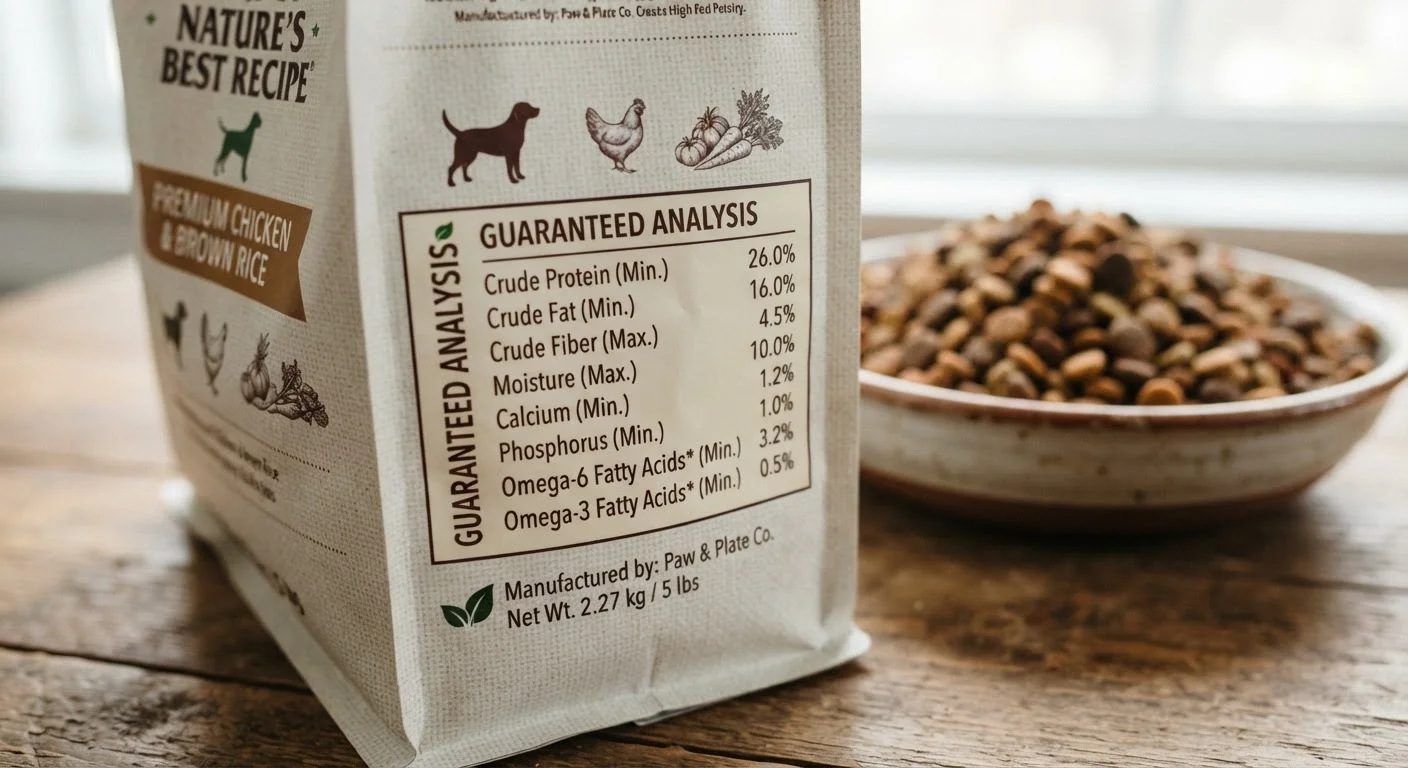
What the Guaranteed Analysis Panel Actually Is
Every pet food sold in the United States is required by the Association of American Feed Control Officials (AAFCO) to display a guaranteed analysis (GA) panel. Think of it as a nutritional snapshot — but one with strict rules about what it shows and how.
The panel must list at minimum four nutrients: crude protein (minimum), crude fat (minimum), crude fiber (maximum), and moisture (maximum). Some manufacturers voluntarily add others, such as ash, omega fatty acids, or specific minerals. Each figure is stated as a percentage of the food as fed — meaning exactly as it comes out of the bag or can, including any water content.
The word "crude" is important. It does not mean low quality. It refers to the laboratory method used to estimate that nutrient. Crude protein, for example, is calculated by measuring total nitrogen in the food and applying a conversion factor — not by directly counting protein molecules. This means the number captures non-protein nitrogen sources too, which is why crude protein is an estimate rather than a precise measure of usable protein.
For a broader look at how label language works, see what pet food labels actually mean.
What you will need
Step-by-Step: Reading the Numbers Correctly
Follow these steps each time you pick up a new pet food product. With practice, the panel becomes quick to interpret.
Locate the guaranteed analysis panel on the packaging
On dry food bags, the panel is usually on the back or side, near the feeding guidelines. On canned food, it may wrap around the side of the label. Look for the heading "Guaranteed Analysis" — it is a required label element, so it must appear.
Identify which figures are minimums and which are maximums
Each listed nutrient will be marked min (minimum) or max (maximum). Protein and fat are listed as minimums — the food contains at least that much. Fiber and moisture are listed as maximums — the food contains no more than that amount. Jot these designations down before comparing products, because confusing a minimum with a maximum leads to inaccurate comparisons.
Convert to dry-matter basis before comparing wet and dry foods
The as-fed percentages include all moisture, making wet and dry foods incomparable at face value. To convert to a dry-matter basis:
- Subtract the moisture percentage from 100 to get the dry-matter percentage. Example: a wet food with 78% moisture has 22% dry matter.
- Divide the nutrient's as-fed percentage by the dry-matter percentage, then multiply by 100.
Example: 10% crude protein ÷ 22 × 100 = 45.5% protein on a dry-matter basis.
Running this calculation for both foods gives you an apples-to-apples comparison.
Check whether the food meets AAFCO nutritional standards
A guaranteed analysis alone does not confirm a food is nutritionally complete. Look elsewhere on the label for an AAFCO nutritional adequacy statement — a sentence declaring the food meets AAFCO nutrient profiles or has passed a feeding trial for a specific life stage (e.g., adult maintenance, growth, or all life stages). The GA panel and the adequacy statement work as a pair.
Put the numbers in context for your specific pet
Once you have comparable dry-matter figures and have confirmed nutritional adequacy, consider your pet's life stage and health. Kittens and puppies generally need higher protein and fat than adult pets. Senior animals or those with medical conditions may have specific needs your veterinarian can clarify. Small percentage differences between two otherwise similar foods are rarely clinically meaningful for a healthy adult pet.
Common Mistakes and How to Avoid Them
Even careful readers stumble on a few consistent pitfalls when comparing guaranteed analysis panels.
Comparing wet and dry food directly
A wet food listing 10% crude protein looks dramatically lower than a dry food at 28% — but after you remove moisture from both, the gap usually shrinks considerably. Always run the dry-matter conversion (Step 3) before drawing any conclusions.
Treating minimum figures as exact values
A "minimum 26% crude protein" label means the food contains at least that amount. The actual content could be higher. Maximums work in reverse — "maximum 5% crude fiber" means fiber is no more than 5%. Neither figure is a precise target; both are regulatory guardrails.
Assuming higher protein always means better
Protein needs vary by species, life stage, and health status. A very high crude protein percentage is not automatically superior, and for pets with certain kidney conditions, lower protein may be appropriate. Always defer to your veterinarian when a pet has a diagnosed health condition. Visit our pet health hub for guidance on managing common conditions through diet.
Small Differences Rarely Matter
If two foods both meet AAFCO standards for the same life stage, a one- or two-percentage-point difference in listed crude protein is unlikely to affect your pet's health in a meaningful way. Focus on the big picture — moisture-adjusted totals, adequacy statements, and your vet's input — rather than chasing marginal numerical differences.
Ignoring the ingredient list
The guaranteed analysis tells you how much of a nutrient is present; the ingredient list tells you where it comes from. Both panels work together. For a plain-language explanation of protein source terminology, see what the ingredient list is really telling you.
This article provides general educational information about pet food labeling and is not a substitute for personalized veterinary nutrition advice. Consult your veterinarian before making significant changes to your pet's diet, especially if your pet has a health condition.