
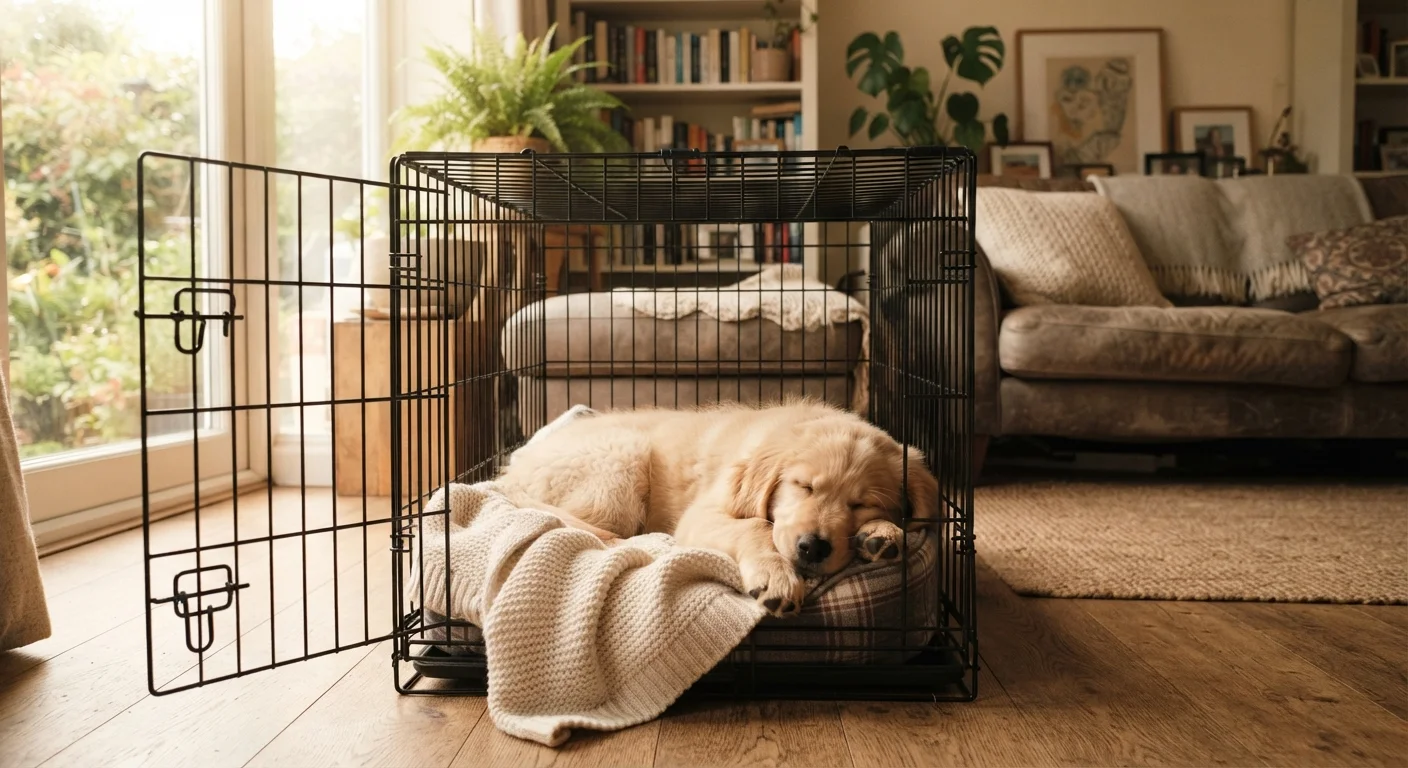
What Crate Training Actually Involves
Crate training means teaching your dog to see a crate — typically wire, plastic, or soft-sided — as a comfortable, safe space rather than a place of isolation. The process is gradual: you introduce the crate with positive associations like treats and calm praise, then slowly increase the amount of time your dog spends inside while you're nearby, and eventually while you're away.
The underlying logic is grounded in canine behavior. Dogs are descended from animals that sought small, enclosed spaces for security. A well-introduced crate can tap into that instinct. It is not, however, a shortcut — skipping the gradual introduction or using the crate as punishment undermines the entire approach. For families weighing their options, it helps to look honestly at both sides before committing.
For a broader view of what the evidence actually supports in dog training, see our guide to common pet training myths.
The Real Advantages of Crate Training
When used correctly, crate training offers several concrete benefits for dogs and their families.
Supports faster, more consistent housetraining
Dogs naturally avoid soiling their resting area, so a correctly sized crate discourages accidents indoors. Veterinary behaviorists widely include crate use as part of standard housetraining protocols for puppies.
Provides a secure, predictable safe space
A dog that views its crate positively has a reliable retreat during loud events, household chaos, or stressful situations. This can meaningfully reduce baseline anxiety for sensitive dogs.
Reduces destructive behavior when unsupervised
Puppies and adolescent dogs chew, dig, and explore everything when left free-roaming. A crate limits access to hazards and prevents damage without requiring punishment.
Eases travel and veterinary stays
Crate-comfortable dogs travel more calmly and handle kennel stays or post-surgical recovery with far less distress than dogs that have never experienced confinement.
Gives children a clear boundary to respect
When children understand the crate is the dog's private space, it reduces unwanted interactions that can stress or startle the pet, lowering bite-risk situations at home.
4–6 hrs
Maximum recommended daily crate time for adult dogs
Veterinary and animal behavior organizations generally advise limiting crating to four to six hours at a stretch for adult dogs, with puppies needing more frequent breaks.
~70%
Dog owners who report using a crate at some point
Survey data from the American Pet Products Association has consistently found that crates are among the most commonly used pet management tools in US households with dogs.
For households with children, the crate also gives the dog a clearly defined retreat — a place kids learn to respect as off-limits. This reduces overstimulation and the risk of stress-related snapping. You can reinforce this boundary-setting alongside other family training strategies covered in our guide on involving children in pet training.
The Genuine Drawbacks to Weigh
Crate training is not without real risks, particularly when families misunderstand its limits.
Can cause stress if introduced too quickly
Rushing the introduction — placing a dog inside and closing the door before they're comfortable — can create negative associations that are difficult to reverse. Anxiety, whining, and avoidance behaviors are common consequences.
Harmful when used as long-term confinement
Adult dogs should generally not be crated more than four to six hours during the day; puppies need breaks even more frequently. Extended crating without adequate exercise and social time can worsen behavioral problems rather than solve them.
Requires real consistency from all household members
If some family members use the crate positively while others use it as punishment, the dog receives conflicting signals. Inconsistency can slow training progress significantly and erode the dog's trust.
Not suitable for every dog's history or temperament
Dogs with prior confinement trauma or severe separation anxiety may respond poorly to crating, sometimes injuring themselves trying to escape. These dogs typically need a tailored plan from a certified professional.
Easy to rely on as a substitute for proper training
Some owners use the crate to manage every inconvenient behavior rather than addressing root causes through training. This delays genuine learning and can mask behavioral issues that need attention.
Crate Size Matters More Than You Think
A crate should be large enough for your dog to stand, turn around, and lie down comfortably — but not so spacious that one end becomes a bathroom corner. Many owners use divider panels in larger crates to adjust the space as a puppy grows. Getting the size wrong is one of the most common reasons crate training stalls early on.
It's also worth noting that crate training is not appropriate for every dog. Pets with a history of confinement-related trauma, or those showing signs of severe separation anxiety, may need a different approach — ideally with input from a certified animal behaviorist or veterinarian. For comparison on how different training methods interact with a dog's learning style, our article on clicker training vs. verbal cues offers useful context.
How to Decide If It's Right for Your Household
Crate training tends to work well when you have a consistent schedule, the patience to introduce it over days or weeks, and a clear purpose — housetraining a puppy, managing post-surgery rest, or helping a nervous dog decompress. It works poorly when used as a default babysitting tool or deployed inconsistently.
Ask yourself a few honest questions: Can you commit to regular crate sessions with positive reinforcement? Does your dog have enough daily exercise and interaction that crate time is genuinely restful rather than the only time they're calm? Do all adults in your household agree on how the crate will be used?
If your household includes cats, their relationship to enclosed spaces is quite different — our litter box training guide for cats covers how environmental setup shapes feline behavior in its own way.
This article is for general informational purposes only and does not constitute veterinary or professional behavioral advice. Always consult a qualified veterinarian or certified animal behaviorist for guidance specific to your pet's health and behavior.