
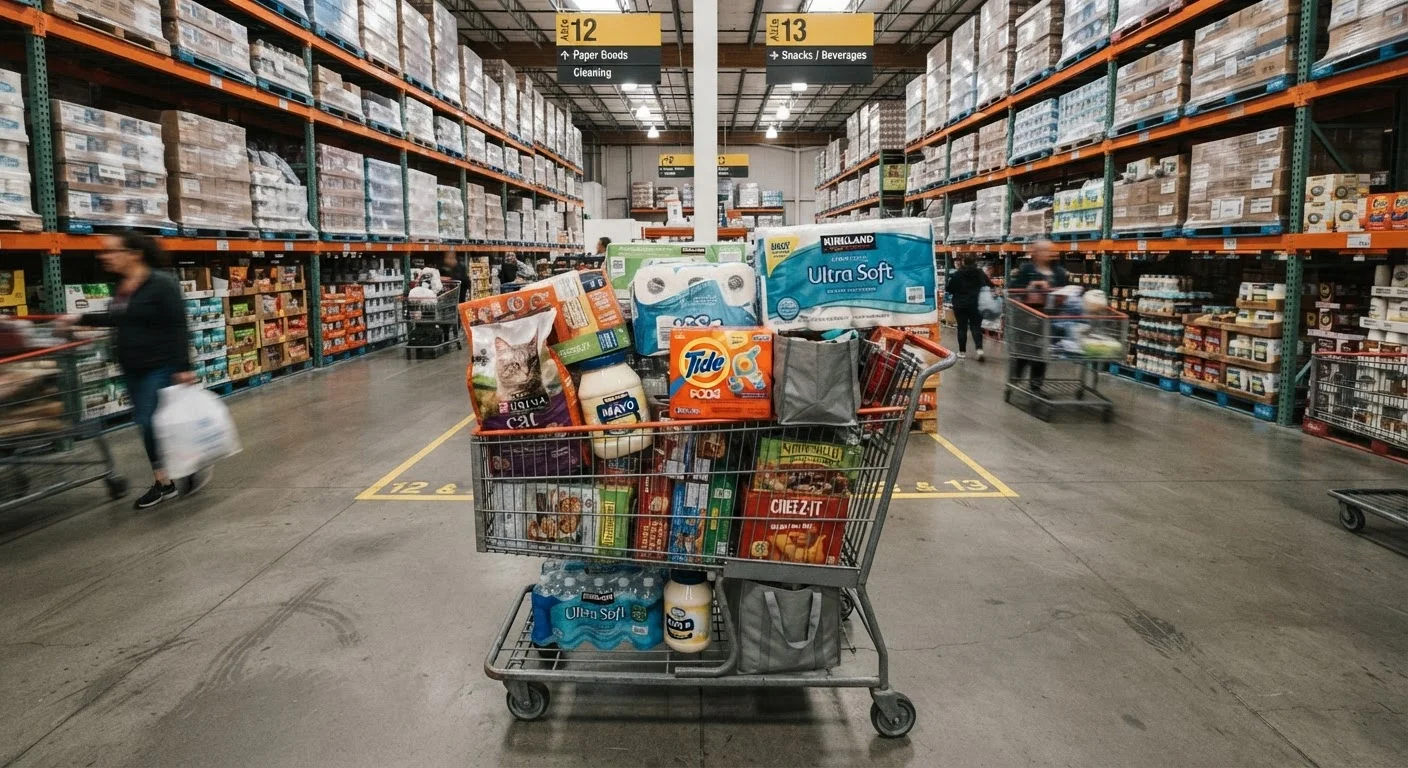
What Bulk Buying Actually Promises
Bulk purchasing operates on one core principle: buy more units at once, pay less per unit. Warehouse clubs, big-box retailers, and online sellers all use this model to move large volumes while giving shoppers a per-unit discount. For a household that uses a product reliably and regularly, that math can genuinely add up over a year.
But the promise only holds under specific conditions. The discount at the shelf doesn't automatically translate to money saved in your household — that depends on storage, spoilage, cash flow, and how your family actually consumes the product. Understanding those conditions first is what separates smart bulk buying from bulk buying that just looks smart.
For context on how hidden costs can quietly erode apparent discounts, see our guide to hidden costs.
Lower cost-per-unit on staples
Buying in larger quantities typically reduces the per-unit price, which can meaningfully lower annual spending on items your household uses consistently.
Fewer shopping trips needed
Stocking up on frequently used items reduces how often you need to shop, saving time and potentially reducing impulse purchases from repeated store visits.
Stable supply of household essentials
Keeping a deeper inventory of staples means your household is less disrupted by short-term supply shortages or price spikes for commonly used products.
Predictable household budgeting
Buying larger quantities less often can make it easier to plan monthly spending, since you're not restocking the same items every few weeks at fluctuating prices.
The Real Disadvantages to Weigh
The downsides of bulk buying tend to be underestimated at checkout. Storage is often the first friction point — large packages require significant pantry, garage, or closet space, and not every household has it. Cramped storage can also mean items get forgotten, expired, or damaged before use.
Perishables carry the highest risk. Buying a bulk quantity of produce, dairy, or bakery items only saves money if your household can consume it before it spoils. When that doesn't happen, you're not saving — you're paying more for food you throw away.
Upfront cash outlay is another genuine trade-off. A larger purchase might look like savings on paper, but if it pulls money from other budget priorities or creates cash flow stress mid-month, the financial benefit is reduced or eliminated. Families managing tight monthly budgets should weigh this carefully.
High upfront cash requirement
Bulk purchases require spending more money at once, which can strain monthly cash flow even when the per-unit price is lower.
Spoilage risk on perishable items
Perishables bought in bulk can expire before a household consumes them, turning a discount purchase into a net loss.
Storage space demand is significant
Large-format packaging requires meaningful pantry, garage, or closet space — a genuine constraint for families in smaller homes or apartments.
Membership fees must be offset
Warehouse club memberships carry annual fees that reduce net savings; households that don't shop frequently enough may not recoup the cost.
Risk of buying items you stop using
Tastes, needs, and brands change. Buying 48 units of a product your family later stops using converts a deal into waste.
~30%
Typical per-unit savings at warehouse clubs
Consumer research generally estimates warehouse club members can save 20–30% per unit compared to traditional grocery or drug store pricing on comparable staple items.
$50–$130
Annual warehouse club membership fee range
Major US warehouse clubs charge annual membership fees in this range depending on tier, a fixed cost households must factor into their savings calculation.
When Bulk Buying Makes Sense — and When It Doesn't
The clearest candidates for bulk purchasing are non-perishable household staples with predictable consumption: paper goods, cleaning supplies, canned foods, dry goods, and personal care items your family uses consistently. These products don't spoil on short timelines, take up manageable space, and get used regardless of season or mood.
Bulk buying is a worse fit for perishables with short shelf lives, specialty or seasonal items your household may tire of, and anything whose quality degrades in large-quantity packaging. It's also a poor match for households with limited storage, irregular consumption patterns, or constrained monthly cash flow.
If you're timing larger purchases around sale cycles, planning purchases around retail cycles can help you capture bulk discounts without overstocking. And for a deeper look at the specific trade-offs of buying ahead during promotions, see stocking up during sales.
Unit Price Labels Are Your Best Tool
Most US retailers are required to display a unit price on shelf labels — typically shown as cost per ounce, per sheet, or per count. Before assuming a bulk package is cheaper, compare its unit price directly to the standard-size package. In some cases, mid-size quantities or sale-priced standard packaging actually beat the bulk unit price. Always check the label before loading up your cart.
Membership Fees and the True Cost Calculation
Warehouse clubs typically charge an annual membership fee — often between $50 and $130 depending on the tier. That fee is a fixed cost that must be recouped through savings before bulk purchasing breaks even. A household that buys only a handful of items per year may not generate enough savings to offset the membership cost.
The honest calculation: add up what you'd spend at a standard retailer for the items you actually buy at the club, compare it to your club spend plus the prorated membership fee, and see whether you come out ahead. Many families find the math works clearly in their favor; others find the savings are smaller than expected once the fee is included.
For a broader framework on how bundling costs and savings interact — in a different context — bundling trade-offs in insurance illustrates similar math. The principle of checking whether a package deal truly saves money applies across many household decisions.