
How Each System Actually Works
Understanding the mechanics of each method helps you see which one fits your household's real routine — not just a budget template you saw online.
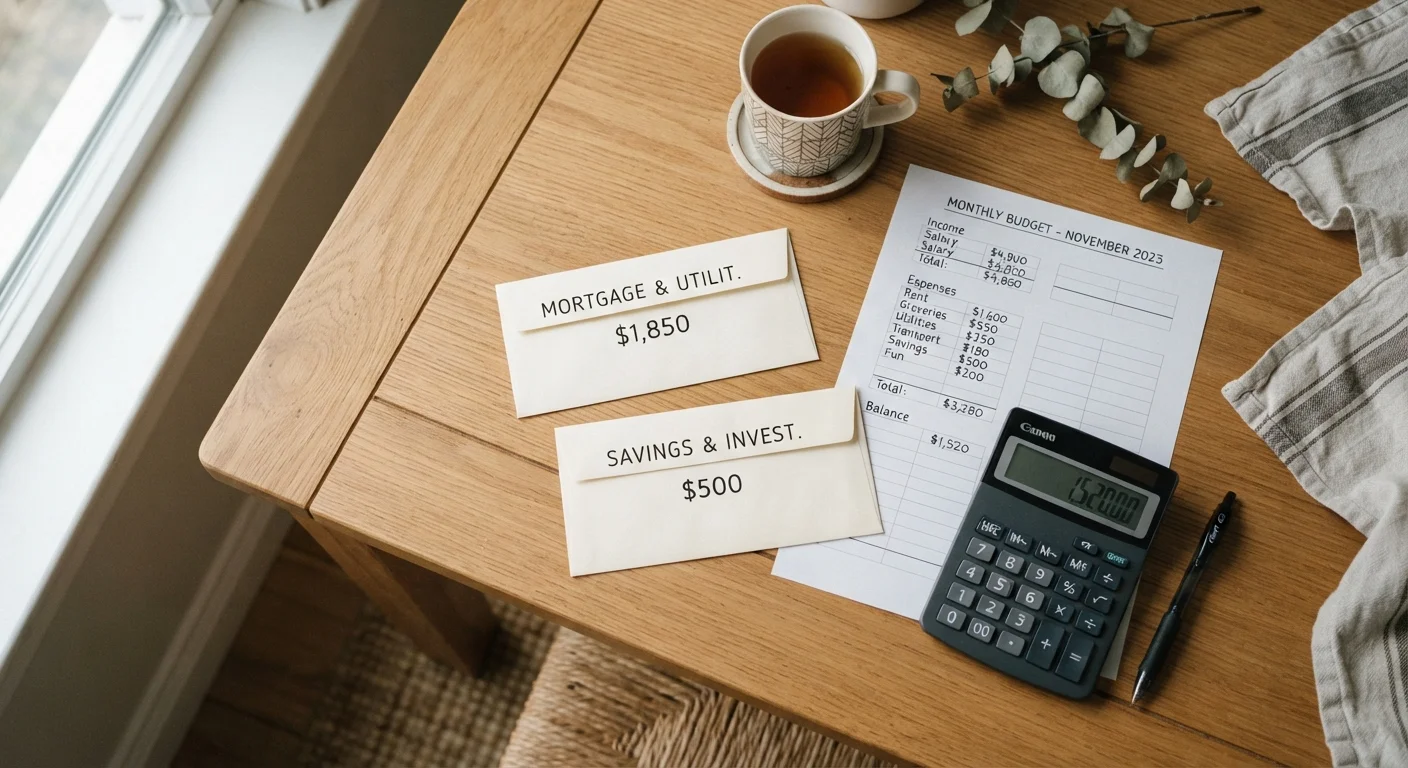
Zero-based budgeting starts with your total monthly income and asks you to assign every dollar a job before the month begins. You create categories — rent, groceries, utilities, savings, kids' activities, clothing — and allocate an amount to each until your income minus your planned expenses equals exactly zero. Nothing is left unassigned. At month's end, you review what you actually spent against the plan and adjust next month's allocations accordingly.
The envelope method is more physical. You withdraw cash at the start of the month and divide it into labeled envelopes — one per spending category. When you go grocery shopping, you take the grocery envelope. When it's empty, grocery spending is done for the month. There's no math to run mid-month; the envelope balance does the tracking for you.
For a broader look at how these methods fit into overall household planning, see our family budgeting guide which walks through building your first spending plan from scratch.
| Criterion | Zero-Based Budgeting | The Envelope Method |
|---|---|---|
| Core mechanism | Assign every dollar a category before month starts | Divide cash into labeled envelopes per category |
| Payment method compatibility | Works with cards, apps, transfers | Best suited to cash spending |
| Setup effort | Moderate — requires category planning | Low — start with a few envelopes |
| Self-enforcing limit | No — requires manual tracking | Yes — empty envelope = stop spending |
| Best for beginners? | Moderate learning curve | Very beginner-friendly |
| Adaptable to irregular income | Yes, with priority-based allocation | Possible, but requires flexible envelope amounts |
| Works for couples or shared budgets | Yes — easily shared digitally | Requires shared access to physical cash |
Strengths, Weaknesses, and Where Each One Trips People Up
Neither method is perfect — knowing the common failure points saves you from giving up too early.
Zero-Based Budgeting
- Strength: Full financial visibility. You know exactly where every dollar is going, including savings and debt payments.
- Strength: Flexible across payment types — works with cards, bank transfers, and subscriptions.
- Weakness: Time-intensive setup. Creating accurate category estimates takes effort, especially in the first few months.
- Common trip-up: Underestimating irregular expenses like car repairs or medical co-pays. Build a miscellaneous or buffer category from the start.
The Envelope Method
- Strength: Hard spending limits are automatic — no willpower needed once the envelope is empty.
- Strength: Extremely beginner-friendly. You can start with three envelopes and add more as the habit forms.
- Weakness: Awkward for digital spending. Paying bills or subscriptions by card requires a workaround, such as tracking those separately.
- Common trip-up: Forgetting to replenish or consolidate envelopes mid-month creates confusion. Set a fixed monthly reset date.
If you're weighing zero-based budgeting against other popular frameworks, our article on zero-based budgeting vs. the 50/30/20 rule offers a useful side-by-side. And if you're wondering whether the envelope method still holds up in a mostly cashless world, envelope budgeting in a digital age covers digital adaptations in detail.
~33%
US adults with a detailed monthly budget
Gallup polling has consistently found that fewer than one in three American adults maintain a detailed household budget, suggesting most families are managing without a formal system.
65%
Adults who say they spend impulsively
A survey by the National Endowment for Financial Education found a majority of adults report making unplanned purchases, which structured methods like envelopes are specifically designed to reduce.
Choosing the Right Fit — or Combining Both
The most important factor isn't which method sounds better on paper — it's which one you'll actually use consistently.
Ask yourself these questions before deciding:
- Do you spend mostly in cash or mostly by card and app? Card-heavy households tend to find zero-based budgeting more practical.
- Are you someone who forgets to check a spreadsheet, or do you prefer a system that runs itself? Envelopes are self-enforcing by design.
- Do you need to coordinate a budget with a partner? Zero-based budgets are easier to share digitally; physical envelopes require both people to access the same cash.
Many households find success using a hybrid approach: zero-based budgeting for fixed expenses and savings goals, paired with physical or digital envelopes for variable day-to-day categories like groceries and entertainment. This captures the planning discipline of one system and the behavioral guardrails of the other.
For guidance on choosing how to track whichever method you adopt, see our comparison of paper budgeting, spreadsheets, and budgeting apps. Additional strategies for managing household debt alongside your budget are covered in the Saving & Debt Tips hub.
This article is for general informational and educational purposes only and does not constitute personalized financial advice. Consult a qualified financial professional for guidance specific to your situation.