
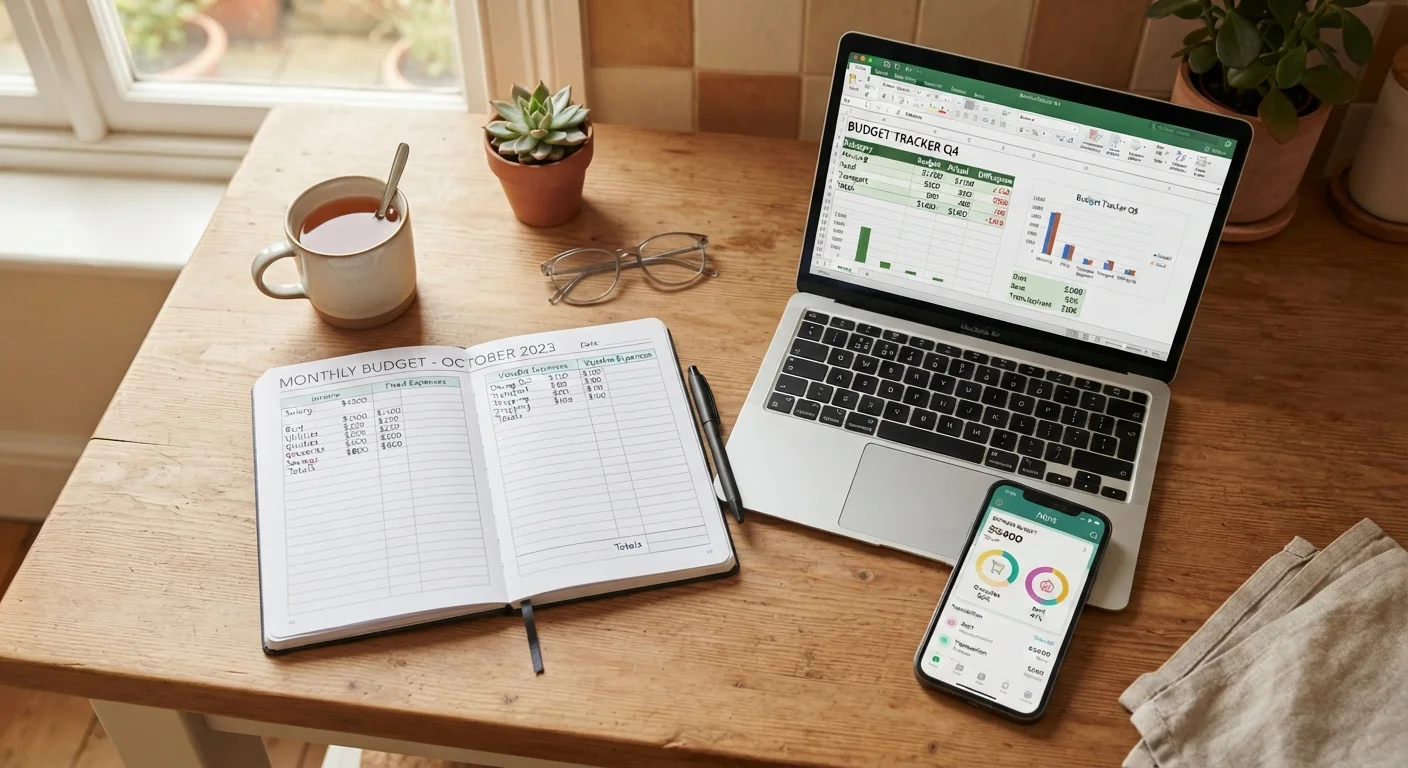
Why Your Budgeting Format Actually Matters
Most budgeting advice focuses on what to track — income, fixed expenses, discretionary spending. But how you track it is equally important. A format that feels awkward or time-consuming gets abandoned within weeks, no matter how well-designed the underlying plan is.
Choosing a method that fits your household's habits is a practical first step. If you've never built a formal budget before, our monthly spending plan guide walks through the core structure — and the format you choose here determines how you'll maintain it. It's also worth understanding that common budgeting myths can stall even well-intentioned efforts before they begin.
Start Simple, Then Upgrade
If you're new to budgeting, starting with pen and paper for just one month can clarify what you actually need in a tracking system. Many people discover that a simple setup works better than a feature-rich app they never open. Once you've built the habit, moving to a spreadsheet or app is straightforward — but building the habit is the hard part.
Paper Budgeting: Low-Tech, High Awareness
Writing your budget by hand — in a notebook, on a printed template, or in a simple ledger — is the oldest method and still a genuinely effective one for many people. The physical act of writing figures down reinforces memory and forces deliberate attention to each number.
Strengths
- Zero cost — pen and paper is already in most homes
- No learning curve or software dependency
- Strong psychological engagement: you feel every dollar you write
- Works without internet access or a charged device
Limitations
- Math must be done manually, increasing error risk
- Easy to lose or damage physical records
- Hard to visualize trends or compare months quickly
- Not practical if multiple household members need access
Paper budgeting pairs naturally with cash-based systems. For a related cash-first approach, see our article on envelope budgeting and whether it still holds up today.
Spreadsheet Budgeting: Flexible and Powerful
A spreadsheet — built in a free tool like Google Sheets or a paid program — sits between paper and fully automated apps. You enter your own data, but formulas do the arithmetic, and you can design the layout to match exactly how your household thinks about money.
Strengths
- Formulas eliminate manual math errors
- Fully customizable categories and layout
- Easy to duplicate month-to-month once built
- Shareable with a partner or co-owner in real time via cloud storage
Limitations
- Requires initial setup time, which can feel like a barrier
- Transactions must still be entered manually
- Basic formula knowledge is needed to build useful dashboards
- Not mobile-friendly without extra configuration
Spreadsheets work especially well when paired with a structured budgeting philosophy. Our comparison of zero-based budgeting vs. the 50/30/20 rule can help you choose a framework to build your template around.
| Paper | Spreadsheet | Budgeting App | |
|---|---|---|---|
| Upfront cost | Free | Free to low cost | Often free; premium features may cost |
| Setup time | Minutes | 30–90 minutes initially | 15–30 minutes for account linking |
| Math accuracy | Manual; error-prone | Automated via formulas | Fully automated |
| Customization | Fully flexible | Fully flexible | Limited to app categories |
| Multi-user access | Difficult | Easy via cloud sharing | Easy via shared login |
| Data privacy | Highest — fully local | High — local or cloud | Lower — linked accounts |
| Best suited for | Hands-on beginners | Detail-oriented planners | Busy, tech-comfortable families |
Budgeting Apps: Automated but With Trade-offs
Dedicated budgeting apps can connect to your bank and credit accounts, automatically categorize transactions, and send alerts when you approach a spending limit. For households with complex cash flows or limited time, this automation can meaningfully lower the effort of staying on track.
Strengths
- Bank syncing eliminates most manual entry
- Real-time balance and spending visibility on mobile
- Visual reports make it easier to spot patterns
- Reminders and alerts support habit-building
Limitations
- Many apps charge monthly or annual subscription fees
- Connecting financial accounts raises legitimate data-privacy questions
- Auto-categorization errors still require manual correction
- Over-reliance on automation can reduce financial awareness
Review App Permissions Carefully
When a budgeting app requests access to your bank accounts, it typically uses a third-party data aggregator. Review the app's privacy policy and understand what data is collected, stored, and shared before connecting any financial account. If you're uncomfortable with account linking, most apps also allow fully manual entry as an alternative.
For families who use apps primarily to find savings opportunities alongside budgeting, it's worth noting how loyalty programs compare to one-time discount apps — the underlying logic is similar: convenience versus control.
Choosing the Right Format for Your Household
Consider these practical questions before committing to a format:
- How comfortable are you with technology? If opening a spreadsheet feels stressful, a simpler paper system will likely produce better habits.
- How many people need to access the budget? Shared cloud spreadsheets or apps work better than a notebook for multi-person households.
- Do you prefer to review once a month or check in daily? Apps support daily check-ins; paper and spreadsheets tend to favor periodic reviews.
- What is your privacy comfort level? If linking financial accounts to a third-party app feels risky, manual entry via paper or spreadsheet keeps your data local.
Many households find that a hybrid approach works best — for example, using an app for day-to-day tracking and a simple paper summary for a monthly family meeting. The full method comparison guide goes deeper on mixing formats.
~1 in 3
US adults without a formal monthly budget
Surveys from the National Foundation for Credit Counseling have consistently found that a significant share of American adults do not use a written or digital budget.
84%
Budgeters who say tracking improved financial confidence
A survey by the American Psychological Association found that people who track spending regularly report meaningfully lower financial stress than those who do not.
This article is for general informational and educational purposes only. It does not constitute personalised financial advice. For guidance tailored to your household's situation, consider consulting a qualified financial professional.