
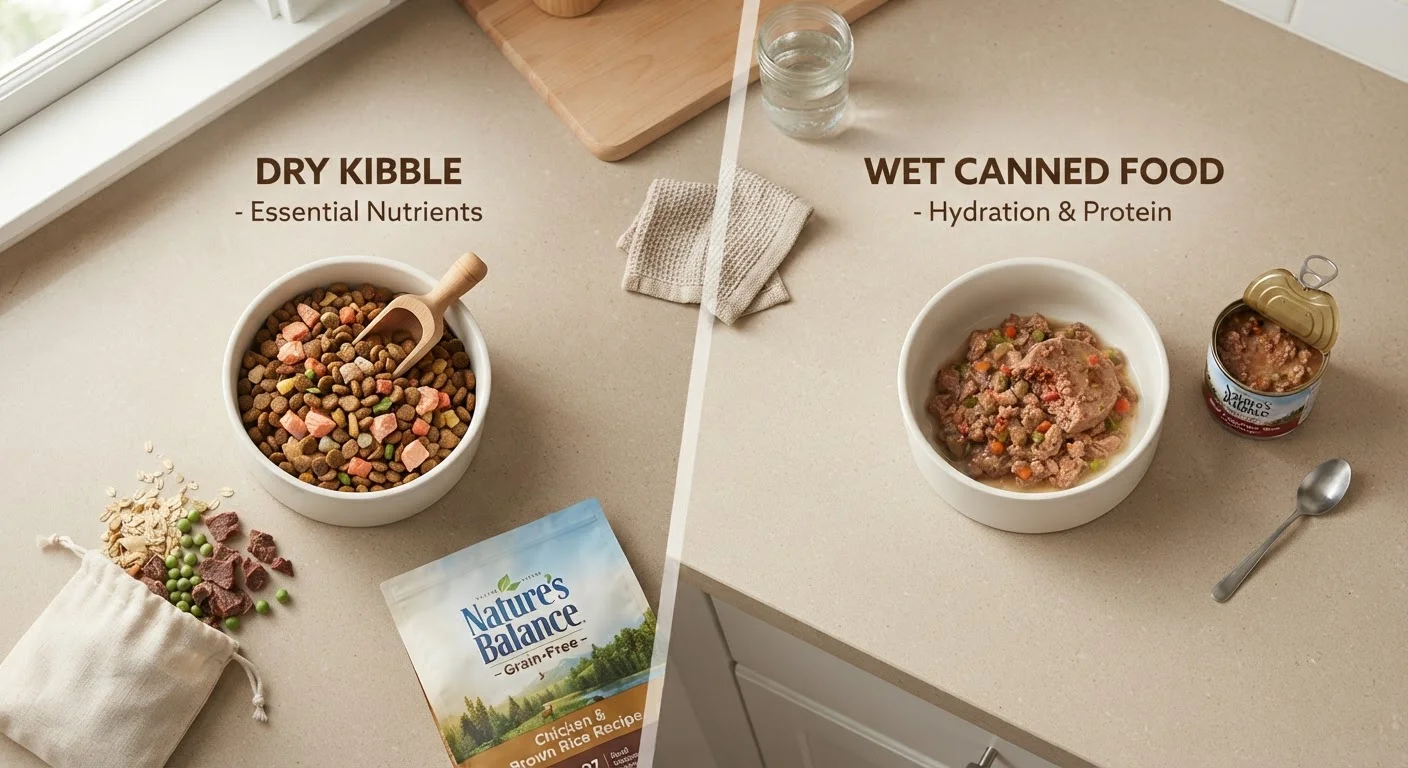
What Actually Differs Between the Two Formats
When families compare dry kibble and wet food, the most important difference isn't taste or texture — it's moisture content. Dry kibble typically contains around 10% moisture, while wet food ranges from 70–80%. That gap has real nutritional and practical consequences.
Beyond water, both formats can be formulated to meet the AAFCO nutritional standards for complete and balanced pet diets. So the question isn't which format is inherently healthier — it's which better fits your pet's body and your household's routine. Understanding how to read a product's guaranteed analysis panel will help you compare formulas on an equal footing. See how to decode a pet food label for a plain-language walkthrough of what those numbers actually mean.
| Criterion | Dry Kibble | Wet Food |
|---|---|---|
| Moisture content | ~10% | 70–80% |
| Cost per serving | Generally lower | Generally higher |
| Shelf life (opened) | Weeks in sealed container | 1–3 days refrigerated |
| Dental benefit | Mild, varies by formula | Minimal |
| Palatability for picky eaters | Lower | Higher |
| Portion control ease | High | Moderate |
| Hydration support | Low | High |
| Suitable for seniors / dental issues | Less ideal | More suitable |
The Real Case for Kibble
Dry kibble's biggest genuine advantages are cost and convenience. On a per-serving basis, kibble almost always costs less than an equivalent wet food formula. It can be left in an automatic feeder, measured easily with a standard scoop, and stored in a sealed bin for weeks without refrigeration — useful for families with unpredictable schedules.
Some vets note that the chewing action involved in eating kibble may provide mild mechanical benefit to dental health, though this effect varies by kibble size and hardness, and it is not a substitute for regular tooth brushing or professional dental cleanings. If portion management and a consistent feeding routine are priorities for your household, kibble is structurally easier to work with.
The main limitation is hydration. Pets fed exclusively on dry food need to drink enough water to compensate. Many cats, in particular, have a naturally low thirst drive and may not drink enough on their own — a pattern that can contribute to urinary tract issues over time.
The Real Case for Wet Food
Wet food's strongest argument is hydration. Because it delivers moisture directly through each meal, it supports kidney function and urinary tract health in a way dry food simply cannot match through nutrition alone. This is why many veterinarians recommend wet food — or at least a wet food component — for cats, older pets, and animals with a history of urinary or kidney issues.
Palatability is another genuine strength. The aroma and softer texture of wet food tends to appeal to picky eaters and pets with reduced appetite due to illness or aging. For a senior dog with sore gums or missing teeth, wet food may be the only format they can comfortably eat. Consistent, adequate nutrition across a pet's life stages is one of the habits vets most consistently emphasize.
The trade-offs are real: wet food costs more, spoils faster once opened, and must be refrigerated after each use. It also cannot be left out in a bowl for extended periods, which limits compatibility with free-feeding approaches.
70–80%
Moisture content in wet pet food
Compared to roughly 10% in dry kibble — a difference with meaningful implications for pets with low water intake.
~60%
Of US households with a pet
According to the American Pet Products Association, the majority of US households own at least one pet, making food choices a widespread family decision.
3–4×
Higher average cost of wet vs. dry food
Wet food typically costs several times more per calorie than dry kibble, a factor that adds up significantly over a pet's lifetime.
Mixing Both Formats: A Practical Middle Ground
Many veterinarians and pet nutritionists support a mixed feeding approach — using dry kibble as the main diet and supplementing with wet food for added moisture, variety, or palatability. This can help families manage costs while still providing hydration benefits and keeping mealtimes interesting for pets.
If you choose to mix formats, the key is adjusting total caloric intake so you're not accidentally overfeeding. Both packages should carry a complete-and-balanced AAFCO statement appropriate to your pet's life stage. Dogs and cats have meaningfully different nutritional requirements, and breed size adds another layer — small and large breed dogs have different caloric and nutrient needs that affect which formulas are appropriate.
If you're considering going further — such as preparing home-cooked meals — it's worth understanding that homemade diets carry real nutritional gap risks without careful veterinary guidance.
This article is for general informational purposes only and is not a substitute for professional veterinary advice. Always consult your veterinarian before making significant changes to your pet's diet, especially if your pet has existing health conditions.