
Why Pet Food Labels Feel So Confusing
Pick up almost any bag of pet food and you'll find a wall of text: percentages, Latin-sounding ingredients, regulatory statements, and marketing phrases all competing for your attention. It's genuinely hard to know what matters and what's noise.
The good news is that pet food labels sold in the United States are regulated — primarily through guidelines set by the AAFCO, a non-governmental body whose standards most states adopt into law. That means the label has a defined structure, and once you know where to look, you can extract real nutritional information quickly.
For a broader look at how label-reading skills apply across your household, the human nutrition label guide covers similar principles for packaged family foods.
What you will need
The Five Sections Every Label Must Include
AAFCO-compliant labels are required to carry five core elements. Understanding each one gives you a reliable framework for any bag, can, or pouch you pick up.
Find the Product Name and Net Weight
The product name is regulated more strictly than most people realize. AAFCO rules govern what percentage of an ingredient must be present based on how prominently it appears in the name. For example, a food called "Salmon for Cats" must contain at least 95% salmon (excluding water). "With Salmon" only requires 3%. The net weight statement tells you how much food is actually in the package — useful for cost-per-ounce comparisons.
Read the AAFCO Nutritional Adequacy Statement
This is the most important sentence on the label. It will say something like: "[Product name] is formulated to meet the nutritional levels established by the AAFCO Dog Food Nutrient Profiles for adult maintenance." Look for two things: (1) the method — 'formulated to meet' vs. 'animal feeding tests' (the latter involves actual feeding trials); and (2) the life stage — 'growth,' 'adult maintenance,' 'all life stages,' or 'senior.' A food labeled for 'all life stages' meets the higher bar set for growth and reproduction, making it suitable for puppies or kittens too.
Scan the Ingredient List
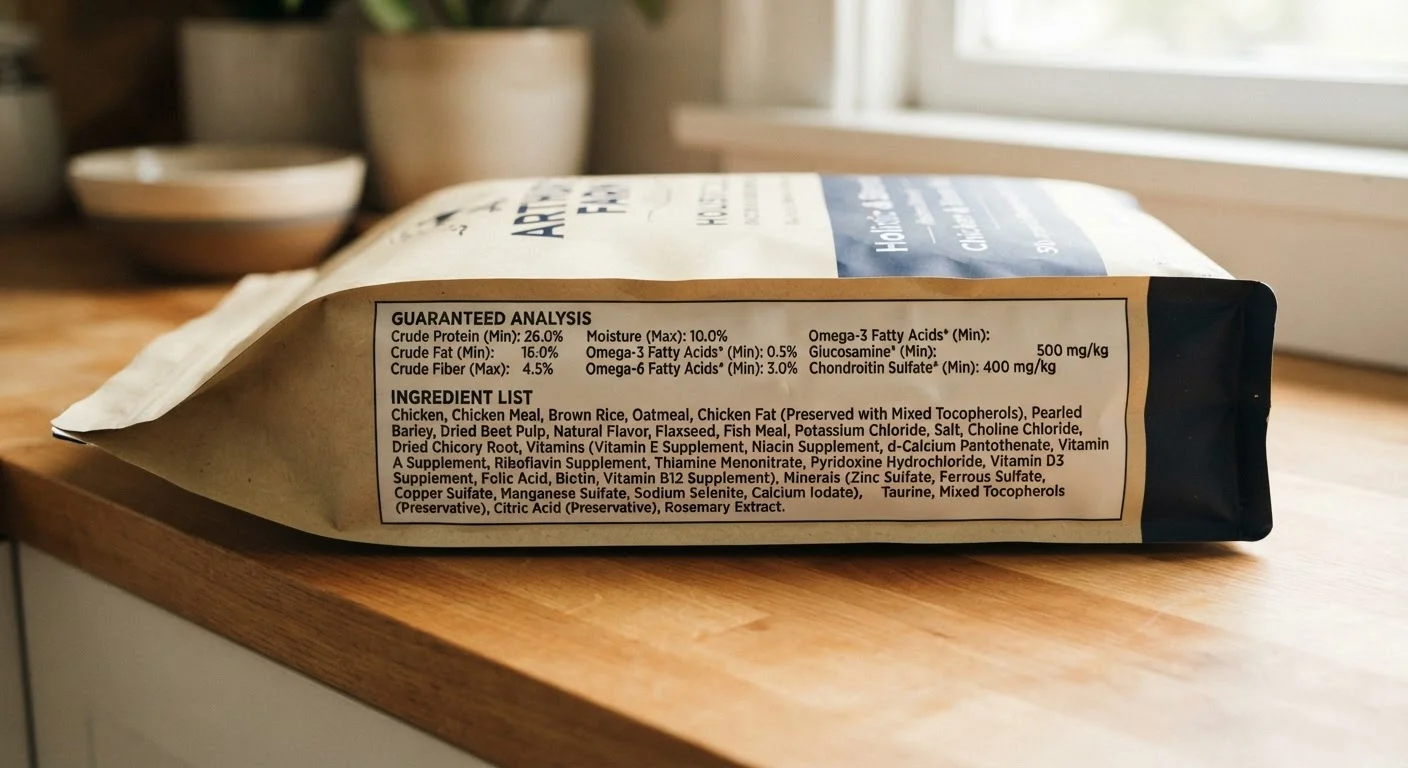
Ingredients are listed in descending order by pre-cooking weight. This means a whole meat like chicken (which contains significant moisture) may appear first even if a dry ingredient like chicken meal contributes more protein by dry weight. The first five ingredients generally tell you the most about the food's nutritional character. Watch for ingredient splitting — a practice where a single ingredient (like peas) appears in multiple forms (pea protein, pea flour, pea starch) to push it lower on the list individually.
Review the Guaranteed Analysis
This panel lists crude protein (minimum), crude fat (minimum), crude fiber (maximum), and moisture (maximum). Note that these are guarantees, not exact values — actual nutrient content may differ. Comparing wet and dry foods using these numbers directly is unreliable because moisture content skews percentages significantly. A dry-matter basis calculation is needed for fair comparison. For a full explanation of how to do this, see the guaranteed analysis guide.
Check the Feeding Guidelines
Feeding guidelines on the label provide a starting estimate of daily portions, usually based on the pet's body weight. These are general recommendations from the manufacturer — they are not tailored to your individual pet's activity level, metabolism, or health status. Use them as a baseline, then adjust in consultation with your veterinarian based on your pet's body condition score.
Once you've worked through those five elements, you'll have a clearer picture of whether a food is genuinely appropriate for your pet. For a deeper dive into interpreting the numbers on the guaranteed analysis panel, see the guaranteed analysis walkthrough.
Common Label Claims and What They Actually Mean
Beyond the regulated sections, most pet food packaging carries marketing language. Some of these terms have legal definitions; others are largely unregulated.
Marketing Language Is Not Regulated Like Nutrition Claims
Terms like 'premium,' 'holistic,' 'ancestral,' and 'restaurant-quality' have no standardized legal definitions in the pet food industry. They appear on packaging to attract buyers but carry no guarantee of nutritional quality. Focus your evaluation on the regulated sections of the label rather than front-panel marketing copy.
- "Complete and balanced" — This phrase is regulated. It means the food has been formulated to meet AAFCO nutrient profiles or has passed a feeding trial. It is one of the most meaningful claims on the label.
- "Natural" — AAFCO defines this as ingredients derived from plant, animal, or mined sources without chemical synthesis. It says nothing about quality or nutritional value.
- "Grain-free" — Describes what the food omits, not what it provides nutritionally. The grain-free science explainer covers what current research says about this diet category.
- "Human-grade" — Has a specific legal threshold under AAFCO. Many uses of this phrase on packaging do not meet the full definition. See the full breakdown of marketing label terms for detail.
For a detailed look at how ingredient terminology works specifically around protein sources, the protein sources guide is a useful next read.
When in Doubt, Ask Your Vet
Label literacy is a useful skill, but it doesn't replace professional guidance. If your pet has a health condition, unusual dietary needs, or you're switching foods after a health change, bring the label to your next veterinary appointment. Many veterinarians are happy to walk through a food choice with you in just a few minutes.
Putting It All Together at Home
Reading labels is a skill that gets faster with practice. A reasonable starting checklist: confirm the AAFCO nutritional adequacy statement matches your pet's life stage, scan the first five ingredients to understand the primary nutrient sources, and note the crude protein and fat minimums in the guaranteed analysis.
Remember that even a well-labeled food can be overfed. The portion size guide explains how to calculate appropriate amounts based on your pet's size and activity level. And if your pet has a health condition, is pregnant, very young, or elderly, always consult your veterinarian before switching foods — general label guidance cannot substitute for individualized professional advice.
For more foundational guidance on feeding pets well, explore the Pet Nutrition hub.
This article is for general informational purposes only and is not veterinary or medical advice. Always consult a licensed veterinarian for guidance specific to your pet's health and nutritional needs.