
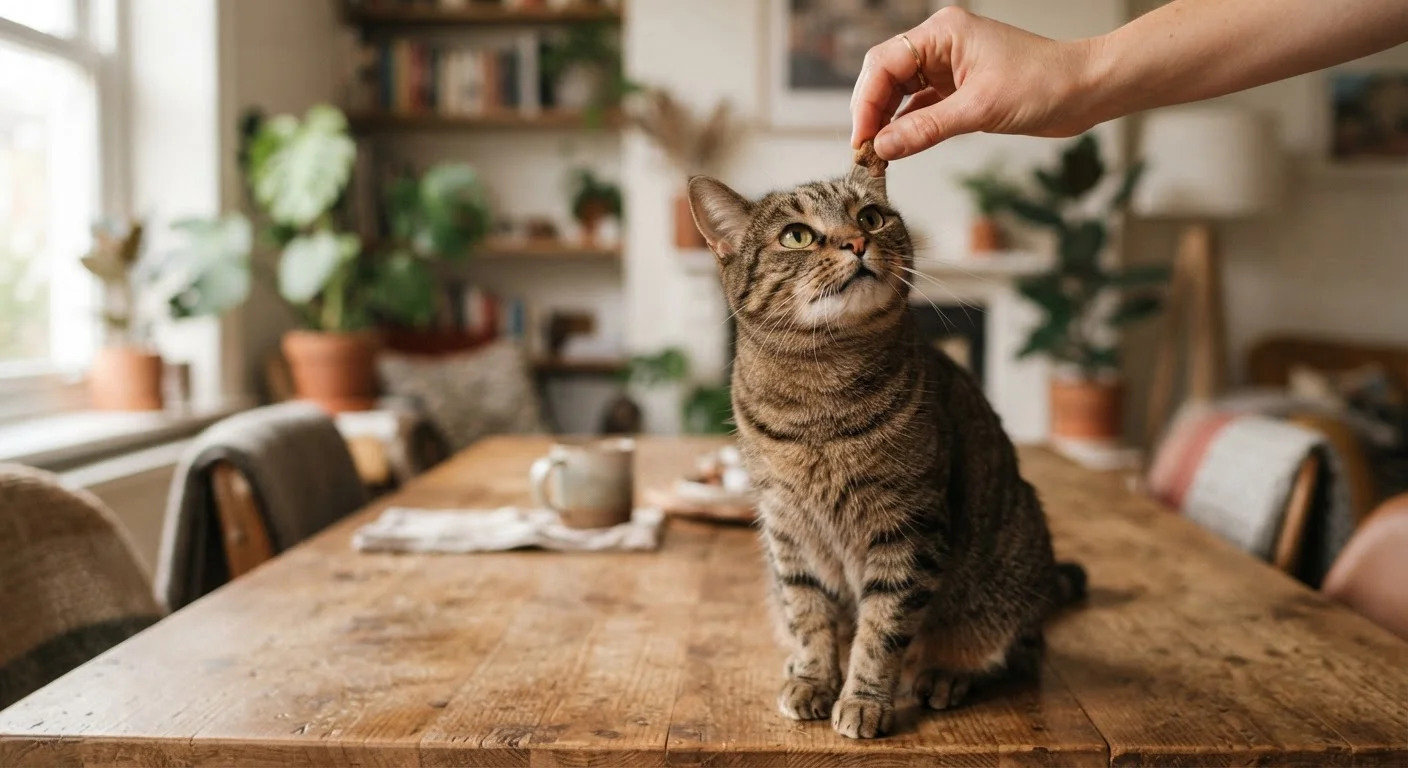
How Cats Actually Learn
Cats are often described as untrainable, but that reputation comes from misunderstanding how they learn — not from any real cognitive limitation. Cats use operant conditioning (learning that their actions lead to consequences) just as readily as dogs do. The key difference is motivation: cats are not pack animals and have no evolutionary drive to please a social leader. They respond to what benefits them.
This means training a cat is fundamentally about making the desired behavior feel rewarding from the cat's perspective. When a behavior reliably produces something the cat values — typically a small food treat, a play session, or a preferred type of attention — the cat will repeat it. When a behavior produces nothing interesting, it fades.
Understanding this framing matters because it rules out entire categories of popular but ineffective approaches, which are covered in the next section.
What You Can Realistically Teach a Cat
The range of trainable behaviors is wider than most families expect. Here's what's genuinely achievable at home:
- Basic cues: Sit, stay, come when called, and high-five are all within reach for most cats using treat-based training.
- Target training: Teaching a cat to touch a finger or a stick with its nose. This is often the easiest starting point and becomes a building block for many other behaviors.
- Carrier comfort: Cats can be gradually conditioned to enter a carrier willingly, reducing stress during vet visits significantly.
- Scratch redirection: Cats can learn to use a designated scratching post rather than furniture, though this requires patience and placement strategy.
- Litter box reliability: While most cats adopt litter box use naturally, specific habits — like using a covered box or a new location — can be shaped. See our guide on litter box training for cats for a full walkthrough.
Cats are also capable of learning more complex chains of behavior, but for most families, the behaviors above represent the most practical and welfare-relevant goals.
What Doesn't Work — and Why
Several commonly used methods are not just ineffective — they actively damage the training relationship.
- Punishment after the fact: Cats cannot connect a correction to something they did minutes ago. Scolding a cat for scratching the couch while you discover it achieves nothing except making the cat wary of you.
- Spray bottles: Squirting water may stop a behavior in the moment, but it teaches the cat to avoid the behavior only when you're present — and it erodes trust.
- Repetition without reward: Repeating a cue word over and over without a meaningful consequence teaches the cat to ignore the word entirely.
- Dominance-based thinking: Cats do not operate within dominance hierarchies the way some dog-training myths suggest. Attempting to "assert authority" over a cat through scruffing or forced holding is stressful for the animal and counterproductive. Many popular training beliefs are outdated — common pet training myths explains what the evidence actually shows.
Avoid Scruffing and Forced Restraint
Scruffing — gripping the loose skin at the back of a cat's neck — is sometimes suggested as a control technique, but veterinary behavior experts generally advise against using it outside of specific medical handling situations. For training purposes, it causes stress and fear that undermine the entire learning relationship. Keep all sessions voluntary: if the cat can leave freely and chooses to stay, you're on the right track.
How to Run a Training Session
Effective cat training sessions are brief, calm, and consistent. A useful structure to follow:
- Choose the right moment: Train when your cat is alert and slightly hungry — not right after a full meal or when they're sleepy. Before a scheduled feeding time often works well.
- Keep it to two to three minutes: Cats disengage quickly. Stop while the cat is still engaged and interested, not after they've already walked away. Our article on timing and frequency for training sessions covers the underlying principles in more detail.
- Use a marker signal: A short, consistent sound — a click from a clicker or a simple spoken word like "yes" — signals to the cat that a reward is coming. Delivered immediately at the moment the desired behavior occurs, this makes the connection clear.
- Reward immediately: Deliver the treat within one to two seconds of the marker. Delayed rewards don't teach the behavior you intended.
- End on success: Finish each session with a behavior the cat already knows well so the session ends positively.
Start With One Simple Behavior
If you're new to cat training, begin with target training — touching your finger. Hold your index finger a few inches from your cat's nose and wait. Most curious cats will sniff or touch it naturally. Mark that touch immediately and reward it. Within a few sessions, the cat begins to understand the pattern, giving you a reliable foundation to build everything else on.
If you have children who want to participate, they can play a meaningful role in age-appropriate ways. Teaching children to participate in pet training offers safe guidelines for involving the whole family.
Common Pitfalls Families Make
Even well-intentioned owners run into predictable stumbling blocks:
- Inconsistency: Different family members responding differently to the same behavior confuses the cat and slows progress. Agree on rules together before you start.
- Treats that aren't motivating: Not every cat responds to the same reward. If your cat is walking away, the treat may simply not be interesting enough. Experiment with different options.
- Skipping easy wins: Jumping straight to complex behaviors before establishing simpler ones makes training frustrating for both parties. Start with target training and build from there.
- Training during stress: A cat that's anxious, overstimulated, or unwell will not learn effectively. If your cat seems off, check in with your veterinarian. General guidance on monitoring your cat's wellbeing is available through our pet health hub.
Cat training requires realistic expectations. Not every behavior will come quickly, and some cats are more naturally food-motivated than others. Progress is still possible — it just may look different from one household to the next.