
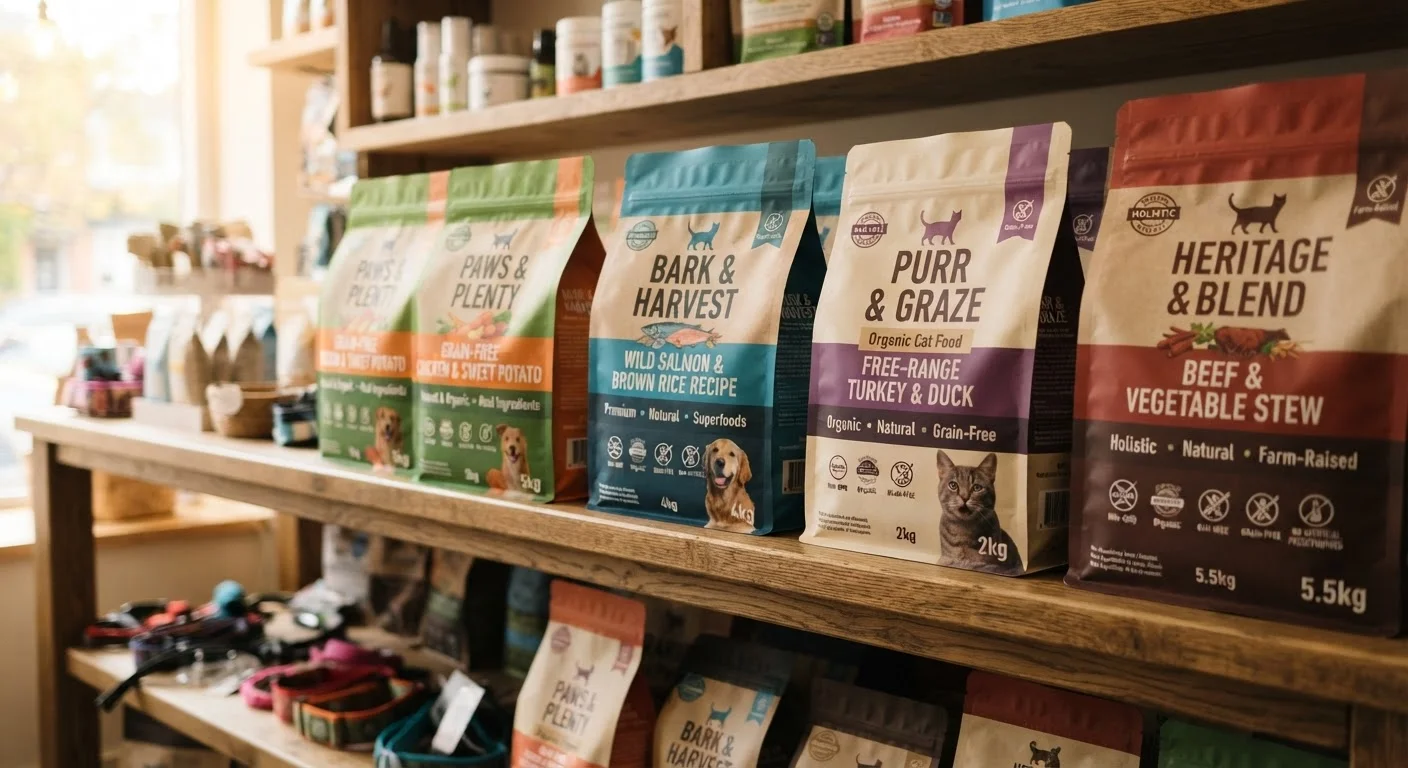
Why These Label Terms Confuse So Many Pet Owners
Walk down any pet food aisle and you'll see packaging loaded with reassuring language: natural, organic, human-grade, wholesome, premium. These words are designed to build trust — and they do. But they're not all created equal. Some carry defined regulatory meanings; others are essentially unregulated marketing phrases that any manufacturer can use freely.
This gap between consumer expectation and regulatory reality matters, because families often pay a premium for claims that offer little or no verified benefit. Understanding what each term actually means — and who, if anyone, enforces it — helps you focus on what genuinely signals quality. For a broader foundation on decoding pet food packaging, see our guide on what pet food labels actually mean.
AAFCO Sets the Standard, States Enforce It
AAFCO is not a government agency — it's an organization of state and federal officials that develops model regulations for animal feed and pet food. These models are then adopted (or not) by individual states, which means enforcement can vary by location. The FDA retains authority over pet food safety at the federal level, including adulteration and misbranding.
"Natural": A Real Definition, With Real Limits
Of the three major claims, "natural" comes closest to having a meaningful regulatory definition. AAFCO — the Association of American Feed Control Officials, whose model regulations most US states adopt — defines the term to mean ingredients derived from plant, animal, or mined sources that have not been produced by or subject to a chemically synthetic process.
In practice, this rules out artificial flavors, colors, and most synthetic preservatives in a product labeled "natural." However, there's an important carve-out: chemically synthesized vitamins and minerals are permitted as long as the label includes a qualifying phrase such as "natural with added vitamins and minerals." This is standard in nearly all commercially complete pet foods, since pets require precise micronutrient levels that are difficult to guarantee from whole ingredients alone.
What "natural" does not tell you: how minimally processed the food is, whether ingredients are high-quality, or whether the product is nutritionally superior. A food can be labeled "natural" and still be a nutritionally mediocre product. Always pair label-reading with a check of the AAFCO adequacy statement and the ingredient list. Our companion article on what the ingredient list is really telling you explains how to interpret those details.
95%+
Organic content required for USDA 'organic' seal
USDA National Organic Program rules require at least 95% certified organic content for a product to carry the organic seal, mirroring standards applied to human food.
~70%
US states that adopt AAFCO model regulations
AAFCO's model pet food labeling regulations are voluntarily adopted by most US states, meaning enforcement and definitions can vary depending on where a product is sold.
"Organic": The Strongest Claim, Rarely Used
"Organic" is the most tightly regulated of the three terms. Pet food manufacturers who use this label must comply with USDA National Organic Program (NOP) standards — the same framework that applies to certified organic human food. This means ingredients must be produced without synthetic pesticides, most synthetic fertilizers, antibiotics, or growth hormones, and the certification process involves third-party verification.
The rules mirror those for human food: a product labeled "100% organic" must contain only certified organic ingredients; a label saying simply "organic" requires at least 95% certified organic content. Products with 70–94% organic ingredients may say "made with organic ," but cannot display the USDA organic seal.
Despite the stricter standard, certified organic pet food represents a small fraction of the market — partly because certification is voluntary, expensive, and logistically demanding. More importantly for pet owners: current veterinary and nutritional research has not established that organic certification translates into measurable health improvements for pets. Whether you value organic production for environmental or personal reasons is a legitimate consideration, but it is distinct from nutritional adequacy.
Check for the AAFCO Statement First
Before evaluating any marketing claim on a pet food bag, find the AAFCO nutritional adequacy statement. This tells you whether the food is formulated to meet established nutrient profiles for your pet's life stage. It's the most reliable quality indicator on the label — and entirely separate from terms like 'natural' or 'human-grade.'
"Human-Grade": Marketing Language With No Regulatory Teeth
"Human-grade" is the loosest of the three claims. No federal regulatory body — not the FDA, not AAFCO, not the USDA — has established a binding, enforceable definition for this term as used on pet food. AAFCO has noted that for a product to legitimately be considered "human edible," every ingredient must be human-edible and the food must be manufactured, packed, and held under conditions that meet federal food safety standards for human food. Very few pet food products actually meet that full threshold.
In practice, many manufacturers use "human-grade" to communicate that they source ingredients that would qualify for human food supply chains — a meaningful quality signal in some cases, but one that is self-reported and difficult for consumers to verify independently. If this claim matters to you, look for manufacturers who are transparent about their facilities and sourcing, and understand you are largely taking their word for it.
For perspective on how label-claim confusion extends beyond pet food, the same dynamic applies to terms on human food products — something our article on reading a nutrition label without the confusion addresses in detail.
What Should Actually Drive Your Decision
Label marketing exists to attract attention. Nutritional adequacy is what actually supports your pet's health. Here are the indicators that carry genuine weight:
- AAFCO nutritional adequacy statement: Look for language confirming the food is "complete and balanced" for your pet's life stage — this is the most important phrase on any pet food label.
- Ingredient list order: Ingredients are listed by pre-cooking weight. A named protein source (chicken, salmon, beef) near the top is a positive sign. See our deeper guide on protein sources in pet food for more.
- Manufacturer transparency: Companies that publish feeding trials, disclose sourcing, and respond to questions tend to be more accountable than those hiding behind vague label language.
If you're navigating grain-free versus grain-inclusive formulas — another area where marketing often outpaces science — our article on grain-free pet food and the science behind it offers a grounded look at the evidence. And for a full walkthrough of every section of a pet food label, reading a pet food label without getting lost is a useful next step.
When in doubt, your veterinarian is your best resource. They can recommend diets appropriate for your pet's species, age, weight, and health status — guidance that no label claim, however well-designed, can replace.
This article is for general educational purposes only and is not veterinary or medical advice. Always consult a licensed veterinarian for guidance on your pet's specific dietary and health needs.